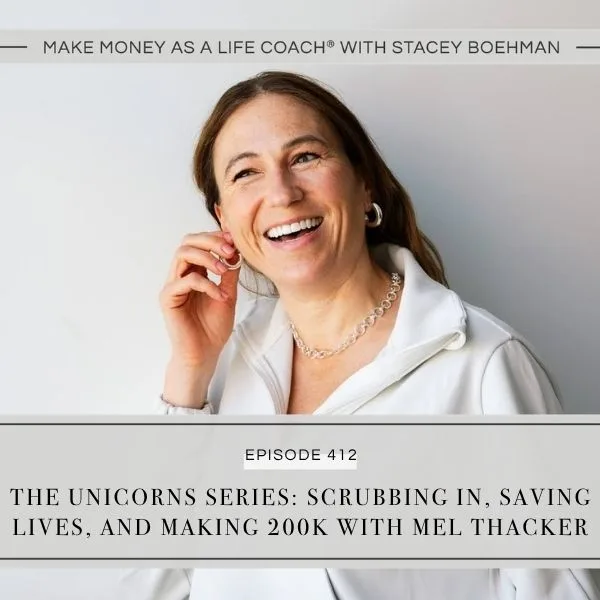
What does it take to become the kind of person who creates extraordinary results? In this episode, I’m joined by my client Mel Thacker, a surgeon, coach, author, speaker, and entrepreneur who grew from just over $20k to a multiple six-figure coaching business. We talk about the identity shifts that happened along the way and what it has meant for Mel to build a career that holds all the different ways she wants to contribute.
Mel shares how learning to work with herself through fear, anxiety, and high-pressure situations has shaped both her work as a surgeon and the way she approaches entrepreneurship. We also explore how she uses coaching spaces, evaluates her own work, and continually turns what she learns into ideas that are uniquely hers.
You’ll also hear what Mel believes has contributed most to the results she has created, including immersion, implementation, service, and a deep connection to the work she wants to put into the world. This conversation is a powerful look at what becomes possible when you trust your own path, keep developing your voice, and let joy fuel the way you show up.
Click here to join the waitlist for the Entrepreneur Coach Membership!
Join us now in the 2k for 2k program with a new 12-payment option — just $200 a month for lifetime access! Click here to sign up. Don’t miss out!
Click here to join the 200k Mastermind waitlist!
What You’ll Learn from this Episode:
- How Mel grew from just over $20k to a multiple six-figure coaching business.
- What helped her expand her identity beyond being a surgeon.
- How she works with fear and anxiety instead of letting them take her out of action.
- Why immersion and implementation have been so important to her growth.
- How evaluating her own work has helped her become more effective.
- Why service and joy are central to the way Mel approaches her business.
- What it looks like to trust your own voice and create a path that is uniquely yours.
Listen to the Full Episode:
Featured on the Show:
- Click here to sign up for the waitlist for the next round of the 200k Mastermind and get on the email list!
- Join my 2k for 2k program where you’re going to make your first $2000, the hardest part, and then $200,000 using my proven formula.
- Follow me on Instagram!
- Follow me on Facebook!
- Click here to get access to all 5 days of my How To Sell Life Coaching training!
- Click here to join the waitlist for the Entrepreneur Coach Membership!
- Apply for 200k Mastermind or join the waitlist here.
- Mel Thacker: Instagram | Website | TEDx | Surgeons with Purpose Podcast | Scrubbing In
Episodes Related to The Unicorns Series, Making 200k, and Mel Thacker:
- Ep #276: Proven Results and the 200k Mastermind Data Study
- Ep #410: Making 200k and Refusing to Choose with Sophia Hyde
- Ep #411: MVP: 3 Types of 200k Businesses & Scaling Time
Full Episode Transcript:

Welcome to the Make Money as a Life Coach® podcast where sales expert and Master Coach Stacey Boehman teaches you how to make your first $2k, $20k, and $200k using her proven formula.
Stacey: Hi, coaches. Welcome to another episode. I’ve decided, I think I’m going to title this series The Unicorns.
Mel: I love it. It’s so good.
Stacey: I was like, “Do I want to call it the top 5%?” I’ve been thinking about it, but I think I’m going to do this series as a private podcast. I love the idea of being able to back-to-back hear. I thought about calling it “How They Did It,” right? Like hear all the stories of how people made this coveted top 5%, 200k. But I kind of like The Unicorns.
So, this is how we’re going to start this episode. If you’re listening, I have a student on here today who is a unicorn. And we’re going to try to get all of her knowledge and anything that we can get from her. We’re going to try to extract a lot of value from this unicorn because I think all entrepreneurs at our core, that’s why we get into entrepreneurship, is we see that there’s a possibility for us to be a unicorn. Obviously, there’s no guarantees. So let me just say that at the very beginning. What my client is going to share with you today, what I’m going to talk about today is no guarantee. There’s no promises. It’s entrepreneurship.
If you Google the definition, you’re taking on extreme financial risk for the potential of extreme financial reward. That’s what we’re all doing here, and we all know it. And we get into entrepreneurship, most of us, some of us are like, “Ooh, hobby money,” and that’s great. But the clients that typically come to me, they’re like, “I’m not looking for pocket change. I’m looking to replace my already multiple six-figure salary,” which I’m so excited to talk to you about. Or they’re like dreaming of I am capable of making multiple six figures, seven figures, multiple seven figures. Like they have big dreams. I had that. And so we got to talk about it. We got to have people on to normalize something that isn’t normal, which is why I think we have to call this The Unicorns.
So, let’s dive in. Welcome, Mel Thacker. How are you today? Introduce yourself. Tell everyone who you are and anything they need to know about you right away before I start just questioning you away.
Mel: Hi, Stacey. Yeah, my name is Mel. I’m a surgeon. I’ve been a surgeon for 13 years post-training, and I still am very, very part-time. I’ve kind of created a mosaic career for myself where my primary job now is coaching surgeons. And I work very part-time as a surgeon. I’m also an author. I recently wrote a book. I’m a podcaster, and I’m the co-founder of a multimedia company called The Hippocratic Collective. And that’s me in a nutshell.
Stacey: And a TEDx speaker.
Mel: And a TEDx speaker. That too. Oh, and a keynote speaker. I get paid to do that.
Stacey: So fun. I just have to take a second for that intro because when I started entrepreneurship and I became a coach, I mean, I would have looked at you and been like, “Oh my God.” Like, “I want that, I want that, I want that, I want that.” Like every coach, I think, wants to be an author, wants to be a speaker, wants to have a community that they serve, wants to make a lot of money, wants to do all of these things. Like they want to be able to express the value of coaching more than just a one-on-one coaching call. Like that’s where you start. That’s the beginning. But like if we want to be big leaders and make big change, we want to be doing all of these things. We want to be writing, we want to be speaking, we want to be doing all of it. The mosaic. I love the idea of the mosaic career.
Mel: Yeah, I know. And I think it keeps us out of becoming codependent with one identity.
Stacey: Yeah.
Mel: If you lit a match to my surgeon career, I’d be like, “That’s fine.”
Stacey: That’s so good.
Mel: Which is powerful. Yeah.
Stacey: I am going through that with my offers right now. I’m in a mastermind and we’re playing around with which offer we might light a match to and which one we might light a fire with. And I feel that same way. I know that no matter where my offers go or what type of way that I make money, I’m going to make an impact no matter what I do. And there’s so much freedom in that. There’s so much freedom in like this leg of my business or this leg of revenue could disappear tomorrow and another one will emerge.
Mel: Yeah, exactly. And I think it’s the idea that our value lives inside of us, which is something that I learned from you, because in training, as doctors, we are taught that our value is determined by a third or a fourth party. And it’s not true. And so it’s such a thought error that a lot of us just live with. And it’s probably why many physicians kind of just put their head down and work instead of speaking their mind. And what you’re talking about is having a voice and sharing your message. We all have a unique message, a unique artistry to share with the world, and you can put it in the outfit of surgeon or whatever, CEO of a company, whatever your day job is. But you can put it in the outfit of coach, you can put it in the outfit of thought leader, speaker, author. There are so many different ways to dress up our artistry.
Stacey: I love that. That’s so good. I’ve always thought of us as artists. I think selling is an art. I think coaching is an art. I think marketing is an art. I mean, just every part, even leadership is an art. Every single part of what we do is we’re making art.
Mel: Yeah, it’s creating. It’s like birthing something into the world. And even line editing my book, my memoir, I was writing kind of my early life, and I got to workshop chapter names with my children and line edit some of the chapters with my children. And it was one of the most, it’s like a core memory that I’m creating with them because I’m creating with them. It’s like brainstorming with them, creating with them. They’re helping me figure out which word do I want to use here? What’s the exact right word? We’re throwing out chapter names. And my son actually named two of the chapters, which was such a fun contribution.
I’ve even like, I made my husband my executive assistant. I’m like, “We need to put you on the payroll.” I’ve created some Roth IRAs for my kids, because I’m like, “You guys are actually helping me. You know, you’re helping my business.” It’s just so fun. Yeah.
Stacey: That’s so fun. I love that. And I imagine, like, the belief system they will grow up with. Like, “Oh, I just helped name chapters. Like my mom was an author, my mom was a speaker.” Like it’s just a very different reality than a lot of people grew up with.
Mel: Yeah, yeah. They look up to me and it’s it’s like that reverence, that whole idea of protecting the asset and modeling self-reverence. And my kids are picking up on that, which is completely opposite of what I grew up with. I grew up with learning self-punishment, self-hate, self-erasure, self-denial. And so I love that I’m just flipping that whole thing on its head and modeling something completely different.
Stacey: I love that you just dropped the concept of self-reverence. That makes me super excited for, I mean, I just geek out about coaching in general, but there might be someone listening at an earlier stage in their business. And I was just coaching on this in the ECM for Standout. And this idea that you are original and what are your original ideas? What is your original voice? And so many of them think, “I don’t have that. There’s nothing new and unique.”
But every day I am working with coaches who create new concepts that are not in the world, or they say it and I’ve never heard it. Or they say it in a way that lands with someone, right? You see this all the time in the 200k room. And that just, like self-reverence, that’s so good. Yeah, I was raised the opposite as well, and I do think that my kids will also grow up with a lot of self-reverence. Like seeing that modeled and then being able to just access that. I think that will be natural for them, and that’s so exciting.
Mel: Yeah, and I you and I, I think have similar stories in that I’m the sole breadwinner of my family. And so in 2024, when I told my husband, who doesn’t bring any income, “You know, I’m going to leave this very stable job as a full-time private practice surgeon, and I’m jumping into the unknown, uncertain world of entrepreneurship,” he’s like, “Okay, I trust you.” And that whole idea of like, the matriarch is the most well-resourced component, like the member of the family that everyone just holds up. My family 100 million percent follows that, that philosophy. And so anytime I hear you talking about that, I’m like, “Yeah, absolutely.”
Stacey: That’s where the lioness… Like we’re always meant to be the ones hunting.
Mel: Yes, exactly.
Stacey: The lions are always the one meant to be protecting the little cubbies. I, you know, whether that’s true or not, it’s a powerful thought for me. I love to think that thought. And I think it makes our family, I don’t know about you, but it makes our family very well-rounded. I think because Neil is with the kids all the time, his maternal side comes out much more. I don’t know what you call that, but he is more kind, more caring, more empathetic, more loving with the kids when they’re hurt than I think he would be if he was working. I don’t think they would get that side of him at all. And he’s such a like alpha dude that it would be really easy for that side to never emerge.
And so now that he’s with the kids all the time, he’s kissing boo-boos too, and he’s holding them when they’re sick, and he’s getting up with them in the middle of the night, and it has made him, not in a bad way, like just so empathetic in a way that I don’t think he would be if he was working all the time and exhausted and not with the kids a lot. Like he’d be like the stereotypical kind of dad. And I think that two kids that are raised that way, it’s like, come on. So good.
Mel: Yeah, no, it’s so good. Yeah, the tenderness. It’s like a tender feminine side that comes out for sure.
Stacey: And he was not raised that way. So I have to point it out to him. I’m like, “Do you see what you’re doing here? You are breaking generational patterns where your son is coming to you, and you’re hugging him and kissing him and caring for his boo-boos, and you’re not telling him to dry it up and…”
Mel: Yeah, suck it up, be a man.
Stacey: Yeah, yeah, he’s not doing that. That is incredible. So, I think as many women breadwinners as we can create, you know, if you want to be a breadwinner, if you want to make a lot of money, why not? And I’m curious about your husband, but I remember asking him like, “What’s your potential? What’s your purpose?” And he was like, “I just want to leave my kids better than me.” Like, better than, “I want to give them a better childhood that I had.” And he had a great childhood, so his expectations are very high. His parents were very lovely. And he’s like, “And I want to, you know, take care of my kids, I want to take care of my wife.” Like, he is like acts of service is his love language. But he was never like, “I have this dream to do this thing,” or, “I love my job or I love working,” or anything that was never his thing. So this is really ideal for us.
Mel: Yeah. No, same with my husband. He had a history, I think he had a history degree in college with a minor in African-American studies. And he never knew what he wanted to do really with it. He worked at a lumberyard when I met him, and he did AmeriCorps, so he helped rebuild Katrina.
Stacey: Oh, wow.
Mel: Yeah. And so he loves serving. He loves serving and working hard, like blue-collar type work ethic. But now he coaches high school tennis and high school golf, and, you know, just for funsies because he loves it. But I think it’s so funny that my kids are like, “Oh, Mom came right around and became a coach just like Dad.” Like we both have kind of the same job now, which is so wild.
Stacey: So cute. Oh my God, I love that. Okay, so can I ask you, because you were a surgeon, I mean, you still are, but when you start, how long have you been a coach? Like, when did you start your actual business?
Mel: I kind of started in late 2023. I actually joined 2k for 2k and I wasn’t certified yet, but as soon as I joined, I got a client. I don’t know how that magic is, but it is.
Stacey: I seriously think it’s like if I were to actually tangibly explain that quickly, I think the moment you’re willing to bet on yourself, you become a magnet for other people to bet on themselves. It’s just something that you become a walking example, and there’s no fancy sales language that can make up for that. You bet on yourself and someone was like, “That’s the energy I want for me.”
Mel: Yeah. No, I do think it’s like a decision because I was also a guest on Amy Vertrees’s podcast. She’s also in the community, and she’s a coach and a surgeon. And she’s…
Stacey: And she’s also made $200k.
Mel: Yes, she’s amazing and she’s my friend and one of my mentors. She was my coach for a while. And so I was a guest and then somebody heard me and then hired me. And then I also joined 2k. And so that was the inception of my business, but I was also working full-time, and I was very new to all of it.
But then 2024 was my year of capacity, I like to think, because that was the year that I pitched and delivered one of two TEDx Talks. I delivered the second one the next year. I started a podcast, I grew my business, and I was a full-time private practice surgeon. And I was able to get to the gym and be present for my family. It was like a new version of me emerged. I was using every single minute of every day so purposefully, practicing my TEDx Talk in the car during my commute when I used to cry on the way to work.
And so it was like a flip, what right? The switch went the opposite direction, where my life was miserable in 2021, 2022. I was even to the point of passive suicidality. I wasn’t sleeping. It was awful. I talk about it in my book. Panic attacks in the operating room, everything. But like you talk about how we can catalyze a painful moment, whatever is our story. You know, like kind of like the model, we don’t get to decide what circumstances are going to drop in our lap. And life is going to rain shit on us. And so that was my flavor of it. But we get to write the ending. We get to author the ending.
And I was able to take that experience and learn from it and transmit suffering and shame into compassion and wisdom and then share it with the world. And so that became my art. It became, just kind of like you selling mops in Walmart, right? It became my story. And like I am the girl with the panic attacks in the operating room. I’m the surgeon who has panic attacks in the operating room and talks about it openly and who says, “It actually made me a better surgeon. I’m a better surgeon today because of it.” And I’m so grateful that I went through that.
Stacey: Why do you think that is? If someone else is having a lot of anxiety right now, maybe in their business, in their life, why do you think that it made you better?
Mel: Because I have such a great emotional vocabulary and I engage with my younger part. I engage with a younger version of me. It’s a child who’s terrified, who doesn’t know that I’m 46 years old. And when she comes up, I used to shove her down and push her into the corner of my psyche, but now I love her and I bring her with me into the operating room and I engage with her and I have a conversation with her. I’m radically transparent with my team.
So when I was having panic attacks in the operating room, I just said to my team, “My human animal does not feel safe. And I just need everyone to know so that I can create safety for my body. And once my body feels safe, then I can continue. And so this is what a panic attack will look like. I will shake just slightly, but then it’ll just move through me kind of like a wave.” And then everyone was like, “Oh, we’ve got you, you know, we love you. We’ve got you.” And that just showed me that people aren’t going to kill me. You know, it showed my human who doesn’t speak in language. And, oh my gosh, I’m going to cry.
Stacey: You’re making me cry. I can’t. This is so powerful.
Mel: Yeah, because it’s like part of me thought that people would kill me if they knew that I was human.
Stacey: Especially as a surgeon, right? Yeah.
Mel: You’re supposed to be robotic and in control at all times.
Stacey: This is so good. So good. And your people were just like, “I’ve got this. I’ve got you.”
Mel: Yeah, they were like, “Oh my gosh, I had a panic attack last week.” They’re like, “We deal with anxiety all the time.” And I was like, “Oh.” And then it was like a deep breath, and I came right back to all of my abilities. And like the strongest version of myself. And so that skill set where I can take something that is terrifying, like panic and dread in a high-stakes situation, and turn it into complete trust and confidence is a powerful, powerful skill set to have.
Stacey: Yeah, that’s why you’re making so much money in your business.
Mel: Yeah. For sure, right? Yeah.
Stacey: Like that’s like I’m thinking about we’re in the Revenue Challenge right now. And for so many people that brings up so much panic and dread and anxiety. And I’m like always telling them, I get that. I really do, like very much get that experience, and you cannot have that wound as an entrepreneur. I mean, you can, but your journey will be very miserable. Like you’ve got to find a way to be like, “Okay, I’m going after a lot of money and I’m going to have fun with it and I’m going to, whatever happens.”
Like, it’s like, I have this experience and you’re probably familiar with this, but I when I had my daughter, they put my line in and I think that it blew and I experienced this like such an intense amount of pain, I can’t even describe. And I was screaming in pain and then I looked at them. My eyes got wide and I said, “Oh my God, I’m going to pass out or throw up. I don’t know what’s happening, but my body feels very bad, very weird, very bad.” And then Neil said my face went white and I just passed out. And they said I had some kind of vagal response, which then turned into an emergency C-section because her heart rate dropped.
But it was the first time where I was like, this was so out of my control. Like my body was just creating a reaction that I didn’t feel like I had any sort of control over. And I think people experience that with anxiety a lot, like in panic attacks and this very physical response to fear, right? Like, my fear was like, obviously, my baby, the heightened situation of being prepped for operating already. It was like they kept moving my C-section up, which was like, why are we moving it up by hours over and over? And like from four to two to 12 to right now, like why are we doing this? What’s happening? And so, like, I think people experience that and it’s very scary to feel like your body is having a reaction that is not within your control. So I think like, when you can have that skill of calming yourself, I mean, that’s the game of life.
Mel: Yeah, and it’s even like the next level beyond like calming yourself, it’s like witnessing without wanting it to be different. I mean, I think of like when I had my kids, you know, I birthed both of them. They were both very traumatizing, by the way. So I completely empathize with your situations. I probably should have had two C-sections. I mean, both of my kids had really low APGAR scores, and it was like the NICU flooding the room, and I’m like, “Oh my God, are they intubating him? Are they intubating her?” But I just have a small frame. I probably was not made to birth a 9-pound… My daughter was 9 pounds.
Stacey: Oh my gosh.
Mel: I know. Yeah, it’s like your uterus is contracting, you’re just like, “Whoa, what the hell is that?” I don’t have any control over that. And I think watching and observing the human body doing what the human body does in dread and panic, it’s like, “Oh, my nervous system is overriding everything because it thinks that I’m unsafe.”
And I don’t know if this is generational trauma, it’s from past wounds, but I have to really pay attention to this and observe it and get curious so that I can repair this because it’s going to come out at some point. If I don’t do this now, I’ll have to do it at, you know, it’ll come up again. I’ll be triggered.
Stacey: So good. I just, I love that you’ve created this skill for yourself. I always think about even if we don’t make the money we want to make, like if someone, you know, doesn’t make $200k or if you don’t make a million or you don’t make $10 million or if I don’t ever make $15 million, which is my goal, it’s like people are always asking me like, “But what do you mean by like the things you’ll learn, who you become along the way?” This is what I mean. It’s like if you become someone who can witness your anxiety, be with yourself, not escape yourself, and move through that in a powerful way, and it not be the thing that now takes you out of life, like the rest of your life living that way, that’s the reason.
Mel: And then traching someone. And then like doing a really hard surgery that’s lifesaving. So the coolest thing is like, these are battle-tested tools. I took them into the operating room.
Stacey: Yeah, that’s so good.
Mel: A couple of months ago, somebody who had a huge head and neck cancer, a really scary, they’re going to lose their airway. And my brain wanted to take me left, and I was like, “Nope, we’re not going to the old way. We’re pure service, show up, just be present.” And I used all the tools and it went as beautifully as it possibly could have. And that guy, you know, he left the hospital, he had an airway, all of the things. It’s essentially lifesaving. It’s literally lifesaving when surgeons learn these tools.
Stacey: So good. I love this so much. Okay, so I want to take this, I feel like there’s a million places I could go, but I want to take this to, at what point did it start to feel like, when you were talking about the mosaic, and you, you know, speaker, author, leader, coach, at what point do you feel like that identity started to emerge for you? Do you remember like how much money you had made, how many years you had been in business? Like, I’m just curious because I’m just thinking of the identity of a coach who’s maybe at $20k, which is like our minimum to start joining 200k. I think if you’re at $20k, $200k should become your next goal. But I recognize a lot of people don’t necessarily have that identity.
So I’m curious like, how that shaped for you, how that identity formed from I’m new, and I’m like I’m starting a business, I’m a coach, and I’ve got a client or two, you know, I don’t know, like I don’t know what that what the circumstances were, but I’m a surgeon. Like when did this sort of turn into I am a mosaic of all of these identities?
Mel: I mean, it was kind of recent that I started to really step into that. I was thinking about this on a walk, and it’s like, now it feels very easy to see myself as thought leader because I have so much content and I have so many followers, and I’m the only one saying a lot of the messages that I’m putting out into the world. So it feels very unique and very me.
But in 2024, I didn’t feel that at all. I made $70k that year, and that was the first real year of my business while I was still working full-time and protecting my revenue. But just growing and trying to build that identity of, “Am I a coach? Can I really do this? People are actually paying me to do this. They’re hiring me.” Clearly they are. And I still didn’t feel like I had a business. I didn’t feel like I was an entrepreneur yet.
And then in 2025, I was very intentional about building that because I actually left my full-time job so that I could do whatever I was going to do. And I was for six months, I didn’t do anything surgery-wise. And then I decided to go back halfway through the year just to make sure I protected the revenue in case I wanted to go back.
It’s also, obviously, a skill set that I’ve trained for so long to be a surgeon, and I love it. I love taking care of patients. And I realized that I have so much joy when I’m doing it very, very part-time. I just didn’t want to be doing it full-time. I wanted to be doing multiple things. Then I started to kind of like really feel like, okay, yeah, this is real. I’m actually an entrepreneur. I’m actually a coach.
Stacey: Wait, how much money did you make in 2025? You went from $70k in your first full year?
Mel: Yeah. To a little over $200k in 2025. And I’m at $224k now this year. My rolling 12 is $338k. I’m going to get to $350k.
Stacey: Holy smokes. That’s crazy. That’s so crazy. So when you were, okay, so 2024 is like, “I’m getting paid for this, but this is not a career.”
Mel: Yeah, I’m dabbling.
Stacey: I’m dabbling at $70k. I love it. Listen, I just have to keep saying like, we’re all a little bit crazy. Yeah. The numbers that were like, “I’m dabbling at $70k.” Like, there are people in the world who do not make this as their full-time yearly salary and they are working 50, 60 hours a week, and we’re like, “Oh, I’m dabbling at $70k.” This is what I mean by like, we’re all fucking unicorns. What is happening? Okay, so you’re dabbling at $70k. And then at $200k, what was your identity? What were you kind of telling yourself?
Mel: I went through Master Coach Training and I was finishing that in 2025. And so now I was starting to really feel like, okay, I’ve got this. I’m understanding my process. I keep going through PSPR. Going through it over and over and over again. You know, I’ve been in your groups, your Mastermind, 200k ever since. And so I think that was a huge component.
Stacey: What do you mean ever since?
Mel: I’m sorry, when in 2024 when I first started. The inception of my business, I got right into 200k. Yeah, it was 2024.
Stacey: How much money had you made when you joined 200k?
Mel: $20k.
Stacey: Oh my God.
Mel: A little over $20k.
Stacey: Yeah. So you are a unicorn. We get every class, maybe 20-ish people who do this, but every time I’m like, these are the unicorns. The people who are like, out of the gate, I’m going big. Okay, so this is crazy. So what was it mid-year then? Did you join like mid-2024?
Mel: Yes. It must have been mid-year. Yeah, it was the July, I think.
Stacey: Incredible. Okay. And then 2025, the identity was starting to emerge because you got master certified and you’re making now $200k. Okay. And then now we’re here where you’re going to make $350k, and you’re like, “I am a mosaic of all of these identities.”
Mel: Yes. And now I’m thinking like, “Oh, wow, I’m a big deal.” You know, I just I interviewed somebody and he was like, “I’m talking to Mel Thacker.” And I was like… I was like, “Oh. oh my gosh”
Stacey: Okay, this is my new goal. I want to help women feel like, “Yeah, I’m a big deal.”
Mel: I know. I can’t even believe I’m saying that, which is it’s very weird because you know, like even if I was in such trauma response anytime I talked to you when I first started getting coached, I was having a full-blown, you know, like anxiety attack on 200k calls.
Stacey: I would have never known.
Mel: But now I can have this conversation with you and I’m like, “Oh, I’m a big deal. I can be as big as Stacey.”
Stacey: Yeah, bigger. For sure. Way bigger. I mean, it sounds like you’re like, you function much, I don’t know what the word is, but it’s like when you describe everything you were doing, I’m like, I don’t consider myself, what is the word I’m thinking of? But like a very… I can’t think of the word. Productive isn’t the right word. I do very well in small bursts. I’ve got about four hours of really good productivity in me a day, and then I need lots of like space. I’m not someone that could be productive for eight hours or 12 hours. I feel like I get diminishing productivity. So I have to be very good in the four the four hours I have a day. So listen, it could be like, the sky’s the limit for you.
Mel: Yeah. No, and I’m hyperproductive. And I have a very interesting process where I tap into the energy, right? You invest so that you can have access to your masterminds. And so I’m always listening to calls on replay. I’m listening to things on double the speed. I have them in my car. They’re in my ear at all times, just so I can feel the energy and then go implement. And then when I get tired, when my brain gets tired, because that’s my morning, after I take my kids to school and say goodbye and all that. And then I go for a run, and that rejuvenates me. It like increases capacity, and I have a burst of creativity typically when my body’s moving, and then I go again. And that’s kind of my process.
Stacey: I love it so much. Okay, so let’s talk about the energy of tapping in because I do that really well as well. So talk to me about that. Because I don’t feel like you come to, I mean, I don’t know, maybe because there’s sometimes there’s a couple of screens, but I think you come like when you need it, and then I am like, “Oh, there’s Mel with her hand raised.” And otherwise, I don’t see you on every single call.
And I’m in the same way in my own coaching. And I think that a lot of people don’t see that as the main, for me it’s like the energy of a container is the main value. There’s of course what I’m going to learn, but there’s something about I could learn nothing and if you tap me into the right energy within myself, I don’t even need to learn anything. I’m going to go kill it with what’s already inside of me.
I was telling someone the other day, I don’t remember where. Oh, it was in 200k. And she was feeling like she’s made like, she’s made, what, $267,000 in the last 12 months or something. And she was telling herself she’s like doing 200k wrong because she doesn’t come to all the calls, or she doesn’t listen all the way to the end. You know, sometimes I stay over. And I’m like, “No, no, you’re doing it right. You tap in, get the energy you need, and then you go do your thing. Like you go into your business.” So tell me how you have used this for yourself.
Mel: It’s the same. For example, I will put on a 200k replay or I will put on an ECM call while I’m going to go get my coffee. And then something will crack open in me. You’ll say something that just, you know, resonates so deeply. And then I sit with that and I investigate what that means, and I try to kind of weave that into the world of surgery to see how it can relate to my clients.
Like a good example would be the belief triad, the sales triad. Belief in self, belief in the client, belief in the offer. That translates beautifully into a surgeon belief triad. Belief in your ability, belief in self, belief in the surgery, and belief in the patient. And belief in the surgery includes not just that the surgery is going to help the patient, because some of us lose belief in surgeries.
Like there’s a great story of this MIT surgeon. He’s a spine surgeon who just lost belief in spine surgery. He’s like, “I operate on their spine and they get better and I don’t operate on their spine and they get better and some people do and some people don’t.” And he just lost belief in the surgery that he was doing, and he stopped being a spine surgeon.
And so if you don’t have an ironclad belief triad, not only in belief in the surgery but the belief in the institution to support you, to have all of the equipment that you need, the first assists, that resonates so deeply with my people. And I borrowed that. It was like, I took that concept that you had, and I just translated it into the world of surgery. And so it’s just one example of many, but I have those moments. I’m like, “Oh my gosh, this is brilliant.” And then I run with it.
Stacey: That’s so good. I love it.
Mel: And I give you credit, by the way.
Stacey: Oh, oh my gosh. You don’t need to. That’s perfect. I love it. Okay, so here’s a fun thing. We didn’t have numbers for 2024. I think that’s probably because that’s when we switched over to the like the main tracker. But I’m curious if you know how much money you’ve made since you’ve been in 200k.
Mel: Well, it was, yeah, $70k, well, so half of that year. So maybe I think it was $30k or $40k that first year, 2024, and then a little over $200k in 2025. And now I’m on track and I think I’m going to end at $350k this year. So it’ll be like half a million.
Stacey: So the numbers from the tracker in 2025 and 2026 that you inputted so far are $523,796.
Mel: Okay, that sounds right. Yeah.
Stacey: And that doesn’t count 2024.
Mel: Okay. Yeah, that sounds definitely right.
Stacey: Same. Like, that’s like unicorn status. So, and I don’t remember, was that, so I’ve changed 20k now so many times. I don’t remember, but were those both $20k investments, 2025 and 2026?
Mel: No. I came in with unbundled price in 2024.
Stacey: Yeah. So for a full year, it would have been $20k…
Mel: Yes, yes. Full for a full year, $20k.
Stacey: So $40k you’ve invested, and you’ve made more than $523,796.
Mel: Yeah, that’s the return on investment. Yes.
Stacey: Okay, so here is my question. That is a unicorn for everyone listening. That is above standard, above par, top percent of people that come into the room. What do you think you did? You, as a person, because if the process and me and everything kind of stays the same, right? I’m a constant. And then there’s the people that come in and they perform above or at average or below average, right? What do you think you did to create this level of return?
Mel: Immersion and implementation.
Stacey: Okay. Tell me more.
Mel: Immersion over and over again because I went through the process. I also listened to all of your live events from the beginning. I’ve listened to them all the way through. Immersing myself in all of the material. Not in like a perfectionistic way where I’m like, “Oh, I have to consume it all.” I took as much time as I needed and listening to the process over and over again.
And I recognize that the first time I listened to everything, the four-step process, I was like, “Oh, you know, I kind of get some of this, but I don’t fully get all of it.” And I just recently listened to it all over again and it hit totally different. I was like, “Oh, now I know what it means to sell.” I didn’t know what it meant to make an offer for the longest time. My brain, I was so confused.
And then another good example would be the webinars course. I listened to it and I was trying webinars. And then I totally understood what it meant when you’re selling with the how, because I was overteaching. I realized I just wanted to teach and give tons of value. And now I know the difference between just getting on and giving value and teaching as opposed to selling. And so I’ve been working on that and I recognize that I need to work on that because that is where I kind of glitch, where my brain is like, “Oh, you know, this is an actual process that I need to figure out.” And so when I go back and watch my webinars now, I’m like, “Oh, okay, I can tell that I was not trusting myself. I’m being weird and I’m in my own head when I’m in the selling portion.” And so now I get that. But I didn’t get that for the longest time.
Stacey: It’s so hard to rewatch your own stuff. I just had to do that for myself and I’m like, “Well, no wonder this didn’t perform the way I wanted.” Like I can see it all. I’m like, “Oh, I see this, I see this.” And then the best part is I put it through AI, like the script, and I was like, “Tell me what you saw.” And it was the exact same stuff. So I was like, “Well, here we are.” And I think it’s really important that you do it yourself first so that you can be like, “Okay, like somebody else didn’t press this upon me. I saw this,” right? Which is the core of the launch audit idea.
But it is, even for me, I teach this. It’s so hard to get myself to do it. To like rewatch myself and I’m looking for not like the defensiveness of, “Here’s why I should have, you know, hit my goal or made the money I wanted to make.” It’s like, “This is why this didn’t perform the way that I hoped.” And it was something from a few years ago, but it was still painful. I was like, “Oh.” And then I’m like, “Okay, now I’m ready to re-record. Now I’m ready to do something different.” So I think it is really brilliant that you were willing to go back and rewatch your stuff.
I don’t think in 2k, evaluating, the same this is true always in your business, evaluating, like actually taking a consult and being like, “Okay, let me write down the conversation. What were all the sticky parts? Where did I not shine? Where did I get stuck? Where did I fumble? Where did I pause? Where did I not immediately know the answer? Where did I lose my confidence?”
Like that, doing an evaluation, the amount of people I get on calls where I’m like, “What’s your top three theories about why it’s not working?” They’re like, “I don’t know.” Like, that is such a hard thing to do. And then the next level is go back.
I just gave this feedback to a friend of mine who’s not a coach, but she didn’t sell what she wanted to sell on a launch and I was like… She was like, “My emails were amazing.” And I said, “They weren’t. They didn’t sell.” I was like, “I know you thought they were amazing, but they didn’t sell. So go back and read them and read them from the lens that they didn’t sell and figure out why.” And it’s so hard to do that, especially when you’re in love with your own stuff, but it makes you so good.
Mel: Yeah. And being a writer, like going through the writing process, helps you edit and you become less precious. I think there’s a quote by Stephen King where you kill all your darlings. It hurts to kill your darlings. You’re like, “No, I love that word.” But you have to kill them. And then even evaluating, evaluating from a place of compassion, it’s a muscle to look at your stuff and not self-punish
But I had a revelation recently where I was like, “Oh, punishment doesn’t work. Unconditional love is what works.” And this is what I’m trying to do as a thought leader in the world of surgery because we evaluate our surgeries and we have something called M&M. It is a blame and a shame fest. There’s like an acronym. It’s accuse, criticize, and something else.
Stacey: That’s what surgeons do to themselves?
Mel: No, we all do it to each other. So if somebody is up there talking about what went wrong, how this patient was hurt, and then it’s like, “Whose fault is it?” The peanut gallery starts to give their opinion about what they would have done, and you feel very judged. And it’s just a lot of egos, you know, like people swinging their dicks around. And it’s like a pissing contest.
But then you’re just like, “No, we could do this very differently. We could look at this from a place of true compassion and having compassion for all parties because it’s a limitless resource, and look at what did we actually do well? What could we have done differently? What can we learn from this? What went wrong? Why did it go wrong?” From an objective lens so that you actually have your brain online instead of just like reacting.
Stacey: It’s like, that reminds me of, have you seen the movie… Is it Sully? I can’t remember what his name was, but the pilot who landed the plane on the Hudson. And the whole movie is, it’s Tom Hanks stars in it, and this is a true story. A plane takes off from New York and right as they’re flying over the Hudson, birds fly into the engine and he has a very split second to make a decision to either turn around or land on the water. Like the plane is going down. And so he lands on the water and every single passenger survives, but the process that they go through in the investigation is like tearing him apart, questioning his… They keep running it through a simulator, and they’re like, “You had time to turn around. You had time to turn around. You did something dangerous. Why did you land on the Hudson? You had time. You had time.”
And at the very end, he goes, “You guys are not factoring in human emotion. You’re not factoring in the x amount of seconds it took my body to take in the information, realize what’s happening, weigh the decisions in front of me, and then choose.” And so they took the like, whether it was like 10 seconds or 15 seconds or whatever, that would have taken and put it into the simulator and realized he did not have time to turn around.
Like if you factor in human emotion, that actually changes the simulation of what you would have done and how they… The computer… I think this is so important with AI right now. We’re not factoring, you know, AI does not factor in any sort of human emotion.
So we were doing, you might appreciate this, I’m having my team go through and we’re we’re creating a prompt that creates a really stellar essential portion of every single training in 200k. So like the live events, like if someone just wanted to watch one live event or one, you know, the time that it takes to watch a live event, but they wanted the best of every live event. Or if they go through the five-step process, what’s the best 20 minutes of every single thing if they need to do it quickly the first time around? They want to get the gist of everything. Like I’ve always been teaching essential and immersive path. I’m like, “Let’s actually create one of everything. Like what’s the thing?” And so we’re creating…
Anyways, we’re creating this prompt and the first one that it spit out, I was like, “Okay, but like we have to teach it that humans need context. We need lead-up. We need pauses for power.” Like it’s just going in and being like, “These were the most powerful words. Put it together.” And I’m like, “Okay, we got to like improve our prompt and we got to do a better…” We’ve got to make sure that it makes sense. And it’s a very similar thing where it just doesn’t have that ability to factor in the wave of human emotion and the human experience and the pieces that actually move us or don’t move us and factor in our decision-making. And I’m like, “That’s the piece where we’re all going to have to, as we integrate AI, I think we’re going to have to be careful about that.”
But that’s what it reminds me of is like, you know, he ends up being cleared of all like, you know, liability or whatever, but it was a really powerful and interesting thing of like they kept running the simulation and saying, “You could have done this differently. You could have done this better. You had time.” And if you factor in the human experience, he actually did not have time and he made the right decision.
Mel: Yeah. Yeah, and that’s exactly kind of what I teach my clients too, about. They’ve told me that it works like a charm to kind of do a 90-second just put a lap on the wound if it’s bleeding. You know, it’s like a the shit hits the fan, you get into bleeding, you just tamponade it, you put pressure on it, and then you wait 90 seconds. You have to let everything flush through and tell your team, “I’m not believing my brain during these 90 seconds because I’m going to corroborate a story of catastrophe. And so I need to let this run through before I go and assess.” And then to get into curiosity and then to creatively solve the problem.
Stacey: And they have 90 seconds to do that?
Mel: Oh, yeah, we always have time. You can always put pressure on a wound. If you get into bleeding, you can always tamponade it and give yourself the time to breathe before… I have a vascular surgeon who’s telling me how… And she does like these really complex arterial cases, and she used that, and she was like, “Oh, it went really well.”
But then my senior partner or one of her colleagues who’s a military guy, and he’s like, he took her aside and he’s like, “You can’t let them know you need a moment. You can’t let them know that you’re having those thoughts. I have those thoughts too, but I don’t tell them.” He’s like, “You have to pretend like you don’t.”
And she’s like, “No, I’m going to do it my way.” She’s like, “I’m going the route of radical transparency in the operating room. I’m not going the route of pretending.” And he’s like, “That’s not okay.” So that’s what we’re trying to shift, is we’re factoring in the human piece. Surgeons are humans and so they need a moment to flush through the catecholamines that flood their body when they’re in anxiety so that they can access their highest self.
Stacey: Well, it’s like I think if they understood the human brain, they would realize that’s actually the right way to go, right? Because you don’t want to make decisions from your brain flooding with fear.
Mel: From trauma response, no.
Stacey: Yeah. You want to clear that out and then make the next best decision. That’s so exciting. Like you are literally saving lives.
Mel:Yeah, and that’s the best. It’s preventing it from selecting for the narcissists who are not feeling, you know, who don’t have any empathy. And they’re like, “You know, they could care less if the patient died.” I am helping the people who are highly sensitive who get selected out and they’re like, “I can’t do this. This job is going to kill me.” And it’s like, “No, it doesn’t have to kill you. If you just learn the tools, then you can stay.”
And so we have the empathetic, the people who are caring, the job will destroy them if they don’t have tools. And then the people who are uncaring and treat patients like diagnoses, those are the ones who stay because it doesn’t bother them. So, that’s my role.
Stacey: I mean, I think that’s so true though for all entrepreneurs too, right? Like I think that coaches tend to be highly sensitive and entrepreneurship can very much like chew you up and spit you out when you’re a highly sensitive person and you don’t have these tools, right? It’s like, if you have launches multiple times in a row that go wrong or you get in a consult purgatory or whatever, it’s like, I mean, we are highly sensitive beings that care. So it’s not just like I lost the sale. We carry with us… I mean, at least the people I talk to, we carry with us the problems we didn’t help them solve, the fact that they’re staying in their pain, the fact that we didn’t serve them.
Like, that’s one of the number one things that people tell me when they’re upset not having closed a sale is, “I didn’t help them. I didn’t serve them. I let them down. I saw them in pain. I could have helped them, and I didn’t do the thing that I needed to do to make sure they got help. I let them go,” or I, you know, or if they don’t get them back on a follow-up, they’re like, “I did a disservice.'” It’s like some feeling of I did a disservice, and I think for someone who cares a lot, that carries with you.
Mel: And you said something that really helps me with that. Anytime I’m in that headspace because somebody doesn’t sign up or whatever it is, I don’t convert a consult. I always think like, “Oh, wow, it’s a miracle anytime anybody invests in themselves in coaching.” It is a miracle. And I’m like, “That is where I have to send my brain so that…” I’m like, “I just need to communicate the miracle to them. I didn’t communicate it. It has to be in my power. I didn’t paint the vision. They maybe they weren’t ready.” All of the things. That is where I have to send my brain as opposed to like, “Oh, no, you know, I did something horrible. Somebody got away and I’m not good at this. What’s wrong with me?” Insert your self-worth.
Stacey: I seriously think to this day, even when I choose really powerful thoughts in the face of something difficult, I’m like, “This is a fucking miracle.” Like I really do. Like I see it. I mean, I take responsibility and I own my greatness, but also it’s just like there is some piece of it where every time that my brain picks myself back up and every time I choose resilience and every time I step into responsibility and every time I choose a higher-level thought, I’m like, “This is a miracle” because I see how often and how easy it is to not. And I’ve been with myself so many times when I don’t. If you’re being honest, you see all the times where you don’t choose it. And so it’s just it just does feel miraculous when we when we win the fight against our brain.
Mel: Yes. It’s a fucking miracle. Can I swear? It’s a fucking miracle.
Stacey: And it’s so not the like mainstream thing to invest in your brain. It’s so abnormal. Like I think back to when I’m like selling mops in Walmart and I’m in a Walmart parking lot talking to Brooke Castillo, and she’s like, “I’m sure you’ll find the money.” Like, what did I think that I had any business being a life coach? I’m like, let me go back in and actually, I think I was selling slicers in that store, but I’m like, “Let me go back in and do my next slicer demo, but I’m about to become a life coach.” Like, what did I think? It’s crazy that she believed in me; it’s crazy that I believed in me. It’s a miracle.
Mel: I love it. I wonder if it’s the gritty, scrappy resilience that comes from humble beginnings because I come from poor. And so I’m unafraid. You know, when I was 13, I had nobody in my family was a doctor. I didn’t even know what a doctor was. And I was like, “I’m going to be a doctor.” I’ve been on my own ever since I was 16, you know, growing up with a mentally ill single mother, periods of being unhoused, intense neglect. And I’m just like, “I’m going to be a doctor.” And so that is coaching, right? You just have a thought, and you’re just you create it.
Stacey: And it’s also such a miracle.
Mel: Yeah, it’s a miracle and it’s delusional and it’s amazing.
Stacey: But you know, they’ve done studies and I can’t quote them, I just have heard about them and now, you know, it’s been years, but how successful entrepreneurs tend to have come from traumatic backgrounds as children. And so it’s like you have to develop such resilience as a child that then the thing you have to do to be an entrepreneur is like, “Well, I’m not fending for myself at eight.”
Mel: Yeah, you’re like risk…
Stacey: I’ll make an offer.
Mel: Yeah, exactly.
Stacey: And you just you build such resiliency and that survival as a child, which is not great, but then, okay, well, if you’re willing to transmute that into something really beautiful, that becomes sort of the payoff is now I can do really big things in the world.
Mel: Yeah, and there’s the same data for people who go into healthcare because I think it’s like running toward chaos. I’m sure there’s some component of that. I’m like, “I need to be in chaos and survival.”
Stacey: Oh, yeah. My sister’s in healtcareh… Yeah. My sister went into healthcare and I went into entrepreneurship.
Mel: Yeah, it makes total sense.
Stacey: She’s a nurse practitioner on a neuro unit or was for 20 years. So she’s like, yeah.
Mel: That’s hard.
Stacey: Yeah. She’s like where… You know, she’s the one that has to like deliver…
Mel: Yeah, watching people die. Strokes
Stacey: Brain surgeries, and yes, all of the things. Yeah, it’s so hard. And the amount of people, the turnover, because it’s one of the things where she’s like so many people don’t make it out.
Mel: Oh, yeah. Neuro ICU is, yeah, wild. Almost like a garden of people who are just, you’re keeping them alive with machines, unfortunately. It’s really sad.
Stacey: Yeah. And you have to deliver the news to people that they will not be coming back as who they once were. So it’s like it’s a very, yeah, it’s a very tough job to do. And I think you do have to be like probably a little crazy to do it. But in a good way because it’s also somebody’s got to do that job.
Mel: Yeah, in a good way, absolutely.
Stacey: But so much of what I learned, I think, you know, showing up for my business came from her. Like when people are like, “Oh, I can’t possibly work sick.” And I’m like, “Well, you know, my sister would be the only NP on that floor in a given night. Like it doesn’t matter. She has to show up.” Like it doesn’t matter if, you know, if childcare falls through, she’s got to find somebody else. Like she just can’t call in. And so I always think about, “Well, if she can’t call in, why do I need to call in?” Like let’s just grow my capacity a little bit more.
So I feel like she’s been such an inspiration in that regard. Or like when people are like, “Oh, I can’t sell online, something terrible’s happening in the world.” And I’m like, “Well, my sister still has to go to work.” So I guess I do too, right? It doesn’t matter what’s happening in the world. She’s got to go to work. So there has to be someone there. They can’t not have an NP. And I think about that a lot. It’s like, there’s something about that of that level of show-up that I think has been really helpful for my business, just watching her over the years.
Mel: Yeah, we learned that you can’t call in sick unless you’re in the hospital. And I operated the day I gave birth,
Stacey: Or very contagious, I guess. Yes.
Mel: Yeah. The day I gave birth to my son, I did surgery that morning. And then I went into labor that evening. I was like, “Oh, that’s so wild.” I remember that kid’s name. I’ll never forget the kid who I did surgery on.
Stacey: Okay, so I know we’re at time. I don’t know if you have to go to a call right away. I want to honor…
Mel: Oh, I don’t. Yeah.
Stacey: Okay. So with our few minutes left, is there anything that you can think that is like wisdom you have of having reached this… I mean, seriously, I do believe that you see that you are a unicorn. I wondered what you…
That was the question I was going to ask you, is how you engage with like, does it feel like, “Yes, I am a unicorn?” Does it feel like, “I mean, I recognize this is a big thing, but it also feels very like I’m a normal person doing a big thing,” or does it feel like, “I’m not doing a big thing?” Like how does it feel for you? That’s the first question.
And then I want to know maybe top three or five things that you think has helped you create this. Like for you, what are your thoughts or processes or anything that you can offer to the people listening if they want to be where you are? What would you say to them?
Mel: Yeah, it does feel like I’m a unicorn, and I just actually had that realization when I was going through kind of like old papers from college and medical school. And I was reading some of the evaluations from my college professors and how they saw in me what I didn’t see. And I was like, “Oh, wow, I was precocious, and I was so enthusiastic and really in that service, I have to have an impact kind of mindset from a very young age.” I have to do something big. I’m here for a reason. I have to do something. I have to do something that matters.
nd that’s always carried me forward. And because I think I came from, I almost think of myself as anti-culture. I never heard the word God until I was 10. We didn’t have any religion. We were like nomads. My mom was a gypsy practically. She was doing astrology and tarot cards. And, you know, again, I was neglected. She was more into that than she was into parenting her kids. But I had to figure things out on my own.
And so I learned some version of the model, I think very quickly because I was like, “Oh, I have to reverse engineer the results that I want. Nobody’s telling me how life is done. I have to figure out how life is done.” And so that’s why I think it gives me this ability to adjust and correct course very quickly, as opposed to holding on to very old stories. Stories maybe that were given to many people by their family units or their cultures or even religions, and things that maybe conflict with what they’re trying to do. So I think that is a huge component of the unicornness.
Stacey: Yeah. Yeah. Oh, it’s so good. I love that. Okay, if someone else wants to be a unicorn or thinks that they might be a unicorn and they’re like, “Okay, I want to be at this level,” what are like the top three or five things you would tell them? Like what do they need to know from you?
Mel: Service. It always has to come from service. That whole idea of service energy is so powerful because I think it fuels joy. And joy is a strategy. Nobody outworks somebody who loves what they’re doing.
Stacey: That’s the line of the whole podcast right there. That’s so good. I believe that. And I think there’s no amount of work you can do to make up for that joy. Not having that joy. There’s just no amount of work you can do. If you’re out of joy, this is why desire to me is so important. I’m like if there’s no desire, then what are we doing? I have to get myself to a place of desire. I cannot just make my body move. And then it doesn’t matter anyways. Like if you’re doing something and there isn’t desire, then you got to fix that first.
Mel: Yeah, it’s got to come from a place of like, “Oh my gosh, this is pouring out of me,” right? My book was like… I can’t get this out of me. My social media following was like, “I have to tell them, this is so important.” I would do one or two takes in between seeing patients in clinic. And then one post like one viral from me answering a question.
So I think instead of chasing the virality or like, “Oh, my, am I doing this right? Do I have the right hook?” It’s that black-or-white thinking of trying to do it perfectly. I think you have to throw all of… You have to have that. You know, hold that loosely, but really get into the, “What is my message? Who am I talking to? And how can I say it a million different ways? And how can I say it from a place of like, this is my whole chest saying it because I love it, because I love this message?”
Stacey: That’s so good. I think people really struggle with social media. And even for me, if I struggle on social media, it’s always because our brain is like it slips into, “There’s a formula I’m supposed to follow, a process for visibility or virality or whatever.” It’s like, “This is the way everyone’s doing it. You start thinking about the hook, you start thinking about the message is too long, or it needs to be faster, it needs to look this way, or it needs to have this perfect thing,” and you stop thinking about your person.
And I just think there’s like, I don’t know, maybe it’s the same for everyone, but I think for coaches especially, we have a harder time moving if the energetic equation is not right. We really, it’s an uphill battle if we’re not in service and we’re not in joy and we start slipping into, “This thing I have to do and boxes I have to check to get something.” It’s just not the natural order of things for a coach.
Mel: Yeah, I agree. And I mean, I have 60,000 followers on Instagram and I was doing Reels, and I didn’t know that they were called Reels. I was like, “Oh, is that when you look in the camera and talk?”
Stacey: So good.
Mel: Yeah. So, anyway, you don’t have to know anything about social media and you can grow a following, I think if your message is that meaningful to you.
Stacey: Yeah, that’s so good. All right, anything else you think they need to know?
Mel: Yeah, and you’re one thought away. My podcast have now 121 episodes and over 60,000 downloads. It all was born of the thought, “If this helps one person, it will all be worth it.”
Stacey: So good. Okay, should they buy your book? Tell me about your book.
Mel: Yeah, totally. Yeah, it’s Scrubbing In: A Surgeon’s Journey from Self-Doubt to Wholeness. It’s about my early life and how that kind of shaped me. It starts out with me having a panic attack during a case. I think one of the first lines is like, “What the fuck is wrong with me?” And I’m in my office, crumbling to the floor as a patient is waiting for me to operate. And what do I do when my hands don’t work?
And then it goes into… oh, by the way, you are in the book. Oh my God, you’re in the book. I named my coach. I created an amalgam, so coaching is kind of the vehicle through which I heal because it is a huge component of my journey. And so I named my coach who represents many, Stacey Sheldon, because I wanted to include my friend Steff, who was a huge person. And then Stacey, so your, her name is Stacey Sheldon and she’s a physician coach. And she’s named after you because you were a huge part of it. So yeah, you are in the book.
Stacey: Oh my God, thanks so much. I can’t wait to read it. I’m so excited.
Mel: Yeah. Okay, so tell us more about the book. Yeah. And so then it takes you through my childhood. So I meet with the coach and then we go, she’s like, “Hey, have you ever felt this before?” And it goes back to my childhood, and then you kind of understand where I came from. And then it goes into an arrival fallacy moment where I’m like, “Oh, I have everything I’ve ever wanted. Why am I unhappy?” And then it gets kind of dark. And then I go through healing and it comes back to me being whole again. It’s a book about imposter syndrome, about complex PTSD, about childhood trauma, about the arrival fallacy, about external validation. I don’t use any of those words, but that is ultimately what it’s about.
Stacey: Where can they get it at?
Mel: Amazon. Scrubbing In. Amazon or wherever.
Stacey: I love it. We love to read books as coaches. Everybody needs to go get their copy. Scrubbing In. How can they find you outside of this episode? If they want to follow you, if they want to see what you’re up to and what you’re doing, how can they do that?
Mel: Instagram is the easiest, I would say, @the_surgeon_coach.
Stacey: Okay. And we’ll have that linked up in the show notes. We’ll have your book linked up in the show notes, your Instagram. What’s your podcast?
Mel: Surgeons with Purpose.
Stacey: I love it so much. So good. Thank you so much for being on. I love how each person I speak to, there’s a completely different perspective, a completely different message. It’s really beautiful. It shows me that every single unicorn out there, it’s like a snowflake. There is no two exact that are the same.
And, you know, I want to just like leave that with everybody listening. We spend a lot of time looking for someone that represents something similar so that we can have safety in like let me move forward in this way, the way this person did. And I think if you want to be a unicorn, part of that is I’ve got to listen to me. I’ve got to see my path might be very uniquely different than anybody else’s. Surgeon, full-time coach, back to surgery, author, speaker, TEDx. Oh, can we link up your TEDx Talk too? I actually talked about your TEDx Talk so many times.
Mel: So good.
Stacey: I sent it to my sister. I was like, “You’ve got to send…” I just think it was so… I’ve also had some experiences with doctors where they’re like that exact experience that you talked about in your episode.
Actually, in fact, can I just say this one thing before we get off here? I have to tell you a quick story and I want to credit you with this. I believe I had seen your TEDx Talk prior to this. I could be wrong. Maybe I’m just, I don’t know. But I had a very similar experience.
My daughter was in, when she was eight weeks old, we had to be admitted to the hospital, the big children’s hospital. She had like a spot that had gone on her head and then it had kind of gone away. And I had, for whatever reason, I’ll never know because I never had these in my life, but I got so many cold sores when I was pregnant with her. Like so many. And I had one and I was nursing her and I had kissed her that morning and one sort of like, it looked like one had appeared on her head. And we took her right away to the doctor and multiple doctors looked at her and were like, “Oh my God, this could be neonatal herpes and we’ve got to like admit her, we’ve got to treat her, all the things.”
The whole time, she’d had a photoshoot that morning and Neil was like, “I think it’s a mark from the bow she was wearing.” And every doctor was like, “There’s no way it could be that. There’s no way it could be that. There’s no way it could be that.” So we got to like, you know, and then they start treating them ahead of time. They have to, you have to start treating it before they get the results back. And it takes three days to get the results back. So they were treating her the whole time in this hospital.
Anyways, the doses are like, I don’t know, every three hours or so. And they had like delayed one or every two hours. They delayed one for shift change. They came in, they were like, “Sorry, we’re a little bit behind shift change, whatever.”
So then the day that we were, we had gotten all the tests back, they were all negative except for one. And they were like, “We’re pretty sure it’s going to be negative. It’s going to come back in the next couple of hours. We’re going to go ahead and give her the last treatment.” And I was like, and it had like made her stomach so upset, and she’s eight weeks old. And I’m like, “Well, do you think if it’s going to be back in a couple of hours and you think it’s going to be negative, can we hold off on this last treatment?” And they were like, “No, we cannot hold off treatments. They must be done every so often.” And I go, “Well, but like you held off for shift change, so could you hold off for this?” And you could see them like computing, like, “Wait, what?” Like short-circuiting a little bit in their brains.
And luckily in this case, they were like, “Oh, actually, you’re right. We could, if we did it for shift change, we could wait.” And then it ended up being negative. And Neil was like, “Yeah, three days in the hospital, an antiviral treatment, and I told everybody it was the fucking bow and no one listened to me.” But it’s just like there’s too much on the line if it’s not.
But that was one of those moments where I’ve had so many other moments where it’s gone the opposite and like we just fired our pediatrician because they wanted to poke her for paperwork and they kept saying, “No, I don’t think she has a thing, but the state requires that we do a follow-up test.” And I’m like, “You’re not doing a follow-up test for paperwork. You’re just not. Like that’s I’m not letting you do that.”
And so I’ve seen that and I so I thought I think everyone should watch it just for their own advocacy for themselves is like it was very wild. You’re just saving people’s lives. You’re creating so much value. It’s so… And it’s like what, 13 minutes TEDx talk? It was very quick, but it was so powerful. She talks about the red swan, the black swan, and the white swan events. And you guys have got to know what that is.
Mel: Yes, you got to look for the black swans.
Stacey: So good. Okay, so we’re going to link that up too. Make sure that we get that so we can link that up. I am so grateful for the time that you have spent with us.
Mel: I’m so grateful for you. I mean, obviously, I wrote about you in my book.
Stacey: I can’t wait to read it. I’m so excited. Well, they can get it on Amazon. You said you’re going to send me a copy.
Mel: I’m sending you a copy, a signed copy.
Stacey: Signed? Signed. Okay. All right, I love it. Thank you so much for being on today and congratulations on way more than $200k and your incredible year. And I cannot wait for your first million-dollar year. Is that on the books? On the table?
Mel: Oh, yeah. Yeah, two years.
Stacey: Oh my God, let’s do it. All right, thank you so much. I will talk to you so soon.
Mel: Thank you, Stacey.
Stacey: Bye.
Hey, if you’re ready to make money as a life coach, I want to invite you to join my 2k for 2k program; where you’re going to make your first $2,000 the hardest part using my simple five-step formula for getting consults and closing new clients. Just head over to StaceyBoehman.com/2kfor2k. We’ll see you inside.