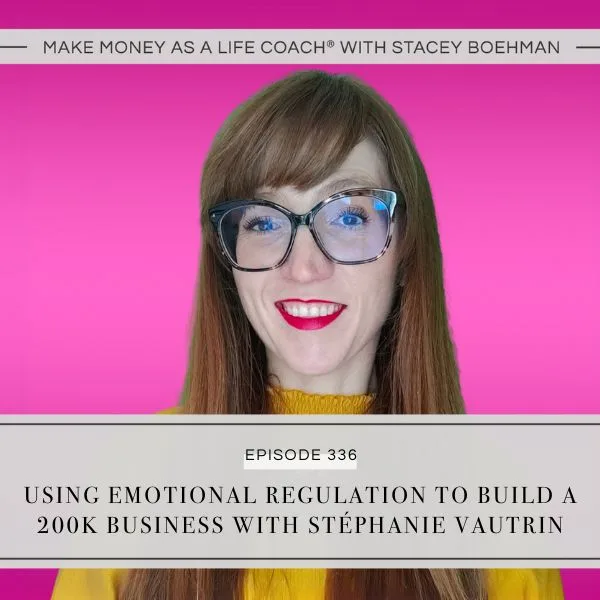
What if the real key to growing your business isn’t another strategy, but learning how to regulate your nervous system? In this episode, I’m talking with childhood trauma coach Stéphanie Vautrin about how healing emotional patterns from her past helped her unlock consistent clients, powerful marketing, and a $270k coaching business.
Stéphanie is a past 200k student and current 2 Million Dollar Group member whose journey shows exactly what can happen when you stop operating from survival mode and start leading from a place of emotional safety. We talk about how childhood experiences show up in business, why rejection and self-doubt often feel so intense, and how to build the internal stability required to take bold action without burning out.
If you’ve ever felt like you’re stuck in your business and don’t know why, this conversation will show you how to reconnect with yourself, trust your voice, and create growth that feels aligned, sustainable, and deeply empowering.
Click here to join the 200k Mastermind waitlist!
Join us now in the 2k for 2k program with a new 12-payment option — just $200 a month for lifetime access! Click here to sign up. Don’t miss out!
I’m making some big changes in my 2 Million Dollar Group! For all the details and to get on the waitlist, click here.
What You’ll Learn from this Episode:
- How childhood trauma manifests as specific business blocks like procrastination, burnout, and marketing avoidance.
- Why emotional regulation is the foundation for consistent business growth.
- How to recognize when you’re operating from survival mode versus “alive mode” in your business.
- The critical difference between acceptance and rejection that determines your success.
- Why your authentic marketing approach will attract clients more powerfully than copying others.
- How to turn around a failing launch by focusing on value rather than taking it personally.
- The simple practice of “giving back” emotional burdens that aren’t yours to carry.
Listen to the Full Episode:
Featured on the Show:
-
- Click here to sign up for the waitlist for the next round of the 200k Mastermind!
- Join my 2k for 2k program where you’re going to make your first $2000, the hardest part, and then $200,000 using my proven formula.
- Follow me on Instagram!
- Follow me on Facebook!
- It’s not too late to join us in 2k for 2k Live!
- Good Inside by Dr. Becky Kennedy
- Stéphanie Vautrin: Instagram | TikTok | Facebook
Full Episode Transcript:

Welcome to the Make Money as a Life Coach® podcast where sales expert and Master Coach Stacey Boehman teaches you how to make your first $2k, $20k, and $200k using her proven formula.
Hey coaches, today I have a really exciting episode planned for you. I have one of my past 200k, current 2 Million Dollar Group students here with me today to talk about making $200k and how she’s done it, and all about her business, and everything that she’s learned that she can share with you.
So, without further ado, please welcome Stéphanie Vautrin from France. I have to say it because we had a whole conversation about how I was going to have a hard time saying her name. But I think I did okay. Please introduce yourself. Tell everyone where you’re from, what you do in your coaching business, what your niche is, and anything else that you think would be relevant to the conversation.
Stéphanie Vautrin: Hello Stacey, hello everybody. I’m so happy to be here. It’s like when you rehearse for the Academy Award or something, like forever. And I’m like, that’s today, I’m on, that’s my time. I’ve been rehearsing in my bathroom for so long for this moment. It’s crazy.
Stacey: I love it.
Stéphanie: You know, I joined 2k in 2019.
Stacey: Wow.
Stéphanie: So it was like we were 500 when I joined, so it was very much the beginning of it.
Stacey: And I did not know that.
Stéphanie: Yeah. And I saw past rounds and rounds of 200k passing by. And at first, I was like, making a million? It doesn’t make any sense for me. And then the more the round came by, I was like, maybe someday. And it kind of grew on me until I reached the point where, okay, that’s my turn, actually. This is my time. I can reach $200k. And now I’m in 2 Million. I mean, are you kidding me? It’s like I’m just not… it’s like I’m still figuring this out. It’s crazy. It’s just crazy.
Stacey: That’s so amazing.
Stéphanie: I’m a childhood trauma coach. I work with people who went through, actually, quite regular childhoods from Boomer parents.
Stacey: Yeah.
Stéphanie: Meaning no room for emotions, a lot of neglect, emotional neglect, and because they were not aware of what they were doing emotionally, basically, we had a roof over our heads. Sorry for the accent, maybe it’s a bit confusing at some point.
Stacey: No, I’m following. I’m here with you.
Stéphanie: If you have a roof above your head, food on the table, and you have clothes on, there’s nothing to complain about. Yeah. So that created a lot of trauma, actual trauma, in a lot of people. So I’m here for those people. I’m here to free them from the impact this had on their life, the survival mode this has created on their life. So when you work with me, basically, in a couple of months, you get rid of procrastination because of the survival mode, or freeze mode. You get rid of chronic stress or anxiety, one of those.
Stacey: Wow. I was getting ready to ask how does this tend to show up for people when they have childhood trauma. So it’s procrastination, freeze mode, not getting done, chronic stress. Anything else that you see a lot of?
Stéphanie: Burnout is like a symptom, a result of a survival mode, but that’s a fight mode. That’s not the freeze mode; it’s a fight mode. It’s the nervous system state where you just need to be in action because otherwise, you feel the stress inside of you, but then you have this limited energy. And when you don’t listen to your body, at some point, you just burn out of energy, and your body says, “Okay, this strategy doesn’t work. So, you know what we’re going to do? We’re going to switch to freeze mode.” That’s like a saving mode, energy-wise. You save your energy because giving too much energy away doesn’t work anymore, so we’re going to go for this one.
Stacey: Yeah, that’s so interesting. I always talk about burnout as people tend to solve it with all-or-nothing thinking, so they go from one end to the other. And I’ve never heard it said this way, but it’s 100% true. The ends of the all-or-nothing thinking spectrum or black and white thinking around burnout is freeze mode or fight mode. Right? I’m either going to fight really hard and burn out, or I’m just going to not do anything and be a little bit frozen instead of that middle ground.
I think this is very interesting. So do you find that the link from childhood trauma, from being in if you were raised kind of without emotional intelligence and without an ability to process emotions and understand what those are, then there’s a lot of shoving down emotions that happens.
And I’m reading Dr. Becky’s Good Inside, very slowly, because I have a toddler. But I am going to finish it. And one of the things that she was talking about is when one of the greatest things that we can do as parents is model emotional processing and emotional regulation, and emotional intelligence. If we can do anything with our children, the best thing we can do is just model what we do with our emotions when they come up and how to handle them, and how to be with them. And she talks about how a lot of people are taught that if they have an explosive emotion, I’m bad, and I’m wrong, and I’m unacceptable, and I’m not liked, so shove it down. If I have any shame, shove it down, shove it all down.
So I can see how, as an adult, my guess is, then if you’ve just learned your whole life, if I have an emotion, shove it down, then you get very far away from the relationship with your body where you know what it’s saying to you. And if you don’t know what your body’s saying to you, then you don’t know how to stop before you burn out. You don’t know how to get started when you’re in freeze mode. There are things that are happening in your mind and your body, and you’re trying to operate in the world without the tools to really work with the things you want to do. And so you’re just constantly working against it. And I can imagine that’s what creates the chronic stress. Am I on the right track?
Stéphanie: For sure, for sure. And the thing is that we’ve learned when we’re a child to overuse our brain to solve things because the world when we were a child didn’t make any sense. Why am I here if I don’t feel connected to my parents? If I don’t feel love, if I have to chase the love, the validation, the connection, the security, it doesn’t make any sense. And usually, this kind of conscientiousness…?
Stacey: Contentiousness? That would be a hard one in another language. I love it.
Stéphanie: …happens around seven years old because this is the age of reason. This is the age where your brain connects the emotional part of the brain to reason, the capacity to resonate, to, no, resonate, to make reason. That’s correct.
Stacey: Maybe. I’m the worst at vocabulary. I think you’re asking, is it reasoning? Like it connects reasoning? Yeah.
Stéphanie: And usually, because I talk to inner children in my work, when this kind of realization of “Why the hell am I here?” happens, it’s when you’re seven because this connection happened. And the child just looks at his world, and it doesn’t make any sense. So because it didn’t make any sense, you have to use your brain a lot to try to make sense, to connect the, okay, so if they don’t like me, it’s because I’m not lovable, I’m not likable. It’s my fault. It’s all on me because it cannot be on my parents.
Because if it’s on them, then I’m screwed because I still have 11 years to go, minimum, and I’m stuck with them. So it has to be me; it cannot be them. I cannot see them any other way than it’s all my fault. And also, because the parents, because they were not responsible emotionally, they blame the children for their own emotions.
Stacey: Yeah. Oh yes.
Stéphanie: So you see how you grow up, and you’re charged with all that background, your backpack, on you emotionally. And then you arrive when you’re a grown-up, and you kind of don’t want to take responsibility for all those emotions because it’s too painful. So that’s why you scroll on TikTok, that’s why you eat the cookie, that’s why you binge, whatever. Because you have to run away from those emotions because they are unbearable; they are too painful.
Stacey: Yeah. Or just why you blame the world, right? It’s because it’s so painful to go inward, so it has to be outside things that are causing it, instead of there’s this internal turmoil. That’s so interesting. I recently saw, I’ve seen this actually a lot. It’s come up on my, I get a lot of kids stuff on my Instagram, but it’s really heartbreaking to think about. It said that if you yell at your kids and you say mean things to them like they’re stupid or why’d you do that and just things that are shaming them a little bit or you’re yelling at them or you’re, any type of just behavior that isn’t your love and connection and kindness, that it doesn’t teach them to not like you and not love you. It teaches them to not love themselves.
That hit me like every time, the first, I’ll cry now thinking about it. When I heard that, I was like, oh my gosh. That is so true. They will internalize it as I am wrong, I am bad. It has to be me. It’s definitely not them, especially because your parents are authority figures as well. So, what powerful work that you are doing for people in the world.
Stéphanie: Yeah, I totally agree with you and that’s actually my own parenthood that draw me to this work because I always swore to myself that I will never be my parents. I would never end up being like my parents. And when my older son turned not even one, I started slapping him on his hands because he was throwing food on the floor. And at the time, I was like, yeah, but what other solution do I have? That’s what I’ve been taught. I did not…
Stacey: Yeah.
Stéphanie: …think like that at the time. It was like, I’m powerless with this behavior, so the only thing I can do is this. This is the only way I know how to cope with this situation. But then I was like, slapping cannot be the only solution. That’s how I turned into nonviolent parenting, and I started listening to shows, reading books, getting trained.
Later on, I discovered the nervous system, and it all made sense. And that’s actually when I had to, because I moved abroad and then we came back, and I had to go live with my mother for one month in 2022. And living with her and my kids, I was like back in childhood, like back to how I felt powerless and unheard, misunderstood, no communication, angry, frustrated. I was back to when I was seven. And I saw how I was behaving with my kids, and I saw how my kids were behaving because of how I was feeling. And it was like, oh my god, this all makes sense. It’s like I had this epiphany of everything makes sense.
And you have to know that at this point in my business, I was struggling. I was making between $10k to $20k a year between 2017 and 2022, when I started my coaching business. And at this time, I had worked on myself. Started working with the rejection wound, which was my big one, and why I was in freeze mode and not being capable of marketing my business regularly.
At the same time, I started making videos on TikTok. And I had this raw material in front of me, like everything makes sense. I have to share it with the world. I mean, it’s very painful at the same time, but at the same time, it’s like, I think I discovered the cure for cancer, seriously. I think I’m really onto something, and finally, my business is aligned because I know what I want to talk about forever.
Stacey: Yeah, that’s amazing. So were you, what were you coaching on before you found this, before you had this epiphany when you were making the $10,000 to $20,000 a year for those five years? Were you just general coaching? Were you coaching on a little bit of everything? What kind of, do you even remember?
Stéphanie: Yeah, that’s what I was about to say. It was very vague. At some point, it was human design because I got some answers with human design, and then it was pivot, business, like when you change careers. Mindset coaching. It was very vague. I couldn’t really grasp it. And this is also what I want to talk about on your podcast is that if you’re at this stage of your business, don’t give up. I know it’s so hard. I mean, my husband was so tired of seeing me struggle with my business, and he had lost all hope that it would work someday.
But it all makes sense now. When I had this epiphany of, “Oh, I understand why it was so hard and why I had to go through all this,” it makes so much sense now that it’s all aligned. And seriously, I have to tell you the whole story. So, 2022 was the worst year ever. I made $2500 for the whole year at the end of August 2022. So, no money. I signed nobody. I got only nos. I had $2500 from recurring clients.
So, in July, I was at my mom’s for one month. My world was upside down. And at the same time, I was creating three TikToks a day because I made an engagement with myself that I would post every day for six months on TikTok, and then I would find a job. August, I could see that some videos started taking off. I got some messages from people. I saw that there was some interest in the topic I was bringing. September, like the real beginning of September, I signed my first client, and then I was like, that’s it, boom. Let’s go, baby, we’re on it. Let’s go. And I ended the year at $31k.
Stacey: Wow. That’s insane. So you were at $2500 in August, and by the end of the year you were at $31,000.
Stéphanie: Yeah. In December, I was making $10k months, and I was like, that was insane. I mean, $31k, I’d never made $31k. It didn’t make any sense. But when your body is regulated, when you’re in security in your life—because after my mom, I found a place of my own with my husband and my kids, and everything was back to normal—I found my routine, I felt secure, my kids were secure, and I could just focus on my business as much as I wanted.
So that’s how I started signing clients and everything. And since then, I’ve just kept growing and growing, and I’m unstoppable.
Stacey: That’s insane. Do you mind if you share a couple more numbers? What did you do after the $31,000 year? What was 2023 like? I’m curious about your growth trajectory after that because I know so many, hundreds of coaches who have been stuck at $10,000 or $20,000 or $30,000 for four or five years. And I have these conversations with them where their spouses are questioning the business, and they are questioning the business, and they’re tired and they’re wondering if they can sustain any longer, and they’re wondering what’s the point.
And I’m always telling them there are so many stories of people that I have known. I had a client who went 10 years without ever making money in her business, and then within two years she had made her first million dollars. Actually, I think she made her first $2 million. It was so fast. So when I see these stories where someone has been at it for a really long time, and then to know where you are now with your revenue, it’s really, I didn’t even know this story, and this is so inspiring. So I don’t know what you’re willing to share, but if you wouldn’t mind kind of walking us through the growth trajectory of kind of where you are now, that would be so amazing.
Stéphanie: Yeah. So, what came to mind first was that I hired someone. I had so much demand at the end of 2022 that I couldn’t handle answering the messages and booking the consults, everything. So I hired someone, and that was one of the reasons for my growth because I manifested this person, for real. I asked myself, “Okay, what do you need?” I need someone to help me with my business. Okay. How are we going to find this person? And the answer came from inside of me: You have to make a story on TikTok. I posted one story on TikTok. The first person, I knew before opening the message, not the person. Second person, I read the message, like, “Okay, sounds good.” And she asked me, “I live in this city. Is it okay with you? I don’t know where you live, but…” And she was living 20 minutes away from me.
Stacey: Wow.
Stéphanie: She is living 20 minutes away from me. So, it’s not like we need to see each other every day, but at some point, it’s nice to see each other sometimes, from time to time. But you see how when you align, when you’re regulated, when you have your purpose, it’s like the universe is just giving you everything you want because you need it, because you ask for it. It just gives you everything you need on a platter. And since I’m regulated, since my body is sending the message that I’m safe and I know what I want and I know where I’m going, whenever I ask, I get what I need.
Stacey: I love this.
Stéphanie: And so, what also helped is every time there is something that I feel like there’s a problem and I don’t know how to solve it, a resource, that’s what it was. Every time I need a resource that I don’t have inside of me, I have no problem asking outside of me, meaning investing in myself, as when I joined 200k.
But when you have been raised with asking for something, for a need that you have, and you were welcomed by your parents by, “Your need is not important,” “What do you have to complain about? You have everything you need,” basically making you feel like your emotional needs were not valid or important enough, you stop asking for help. Or asking for help is shameful, or is dangerous, or you don’t let yourself do it because that’s how you were met when you were a child.
When you don’t have this blockage inside of you, asking for resources is just natural. The same way as setting boundaries—natural, because I’m a grown-up and I can do it. But when you were forbidden to do it when you were a kid because that was making your parents feel insecure that you were saying, “No, I don’t want to do this,” they told you that you were rude, that you were a bad kid, that you should be ashamed of yourself. So you stop setting boundaries.
People don’t understand that we are actually very logical. But the thing is that those traumas are stuck in our body. And most of the time, the work we do is in our head. When you go to therapy, the regular stuff we do is with cognition, with the memories we have in our head. And when you go and you question your body, oh my god, you have no idea how many things it has to tell you. But we don’t question it because it’s not like a common… we’re not used to doing it now.
I’m really advocating for it to be more like a known thing because so much information is stored in your body, and you don’t ask for it. You don’t go question your body; you just stay with your mind and try to solve problems that are not in your mind but are in your body.
Stacey: It’s so good. I love it. So you asked, so you got, you hired someone, then when did you join 200k?
Stéphanie: 2024. I mixed up the year because the funny thing also is that I feel like I bend the time. The time doesn’t make any sense. It feels like the live event, your last live event that I was in, felt like it was three years ago.
Stacey: Oh, it was January of 2024.
Stéphanie: Yeah, but 2024 feels like it was yesterday, but it feels like it was five years ago. It doesn’t make any sense. You know what I mean?
Stacey: Yeah, I mean, I’m it’s actually surprising to me that was your first round. I feel like you were in 200k for so long. It’s so crazy. It’s more recent than I thought.
Stéphanie: Yeah.
Stacey: That’s amazing.
Stéphanie: Yeah. So, 200k was an obvious thing for me. And what I also love is the timing. The timing was perfect. When you announced it was the last one, the live event, I was, “Oh my god, I’m so lucky. I’m so lucky that I got to be here,” because I was listening, I’d heard so many stories of the live event, your marketing around it. I was like, “Oh, I want to be there someday.”
So I traveled the world to be there, and I don’t have the words to describe the experience of it, how amazing it was, how you are in a room with people that have been through not exactly the same things, but quite a lot, in the room with you. So the conversations you have from 9:00 AM until late at night are the best. There’s no other way to describe it. They’re the best. I mean, you go out of the bathroom, you see someone you recognize, you start having the best conversation, so interesting. Everything, I came back home, and I was so powered up. I had so many ideas. I don’t know, it was the best.
Stacey: I’m so glad you got that experience. That’s amazing. I will do more live events in the future. Once I’m done having the babies.
Stéphanie: And I will be there for sure. Because it’s too good. It’s too good to miss.
Stacey: January of 2024 was your first round in 200k. And then when did when was your first year that you made $200k?
Stéphanie: It was 2024. 2023 I made $140k.
Stacey: Oh my gosh. So $30,000 to $140,000. And then I think you went over 200k, right?
Stéphanie: Yeah, I made $270k.
Stacey: Oh my gosh. That’s so wild. Like that growth trajectory is absolutely insane.
Stéphanie: Yeah, it is. And I’m on my way to more, and I’m working on making more in…
Stacey: In the 2 Million Dollar Group. And now yeah, now you’re in 2 Million Dollar Group. That’s so crazy. So, tell, I have a question that’s a little bit, a little off topic, but I am so curious. Your videos are so fun and so amazing. I am curious because they are so much, you play the character of your mom, and then you play the character of you. Does your mom see these videos? Like does she have thoughts about these videos?
Stéphanie: That’s the question that I’m asking myself very often, actually. I don’t have an answer.
Stacey: And what is your thought? Because I have so many people that would never have the courage to if that was their thing, right? And do it so lovely. It’s really, they’ll have to follow you. We’ll make sure that they get your TikTok handle and everywhere that you do these videos, but they’re done very well. They’re very funny. But I know a lot of people that if they had an idea like that, they would never do it because they would be so afraid of, what if my mom saw this? What if my parents saw this? And so what thought did you have that just got you going?
Stéphanie: Actually, I started improv theater in 2008. So, for a long time, I was doing improv comedy.
Stacey: So, this makes sense.
Stéphanie: Yeah, making characters and stuff like that, it was in my blood. It’s something that’s so much fun for me to do. And what my mom… it’s not when I do it, it’s not with the intention of hurting my mom, never ever.
Stacey: It doesn’t come off that way either.
Stéphanie: Yeah. So, it’s just like I know those things. I felt those things. I’ve lived those things, and I’m just recreating them. And those videos are so impactful for people because they are telling me, “Were you there when I was a kid? Did we have a camera or something?” It’s like, “Are you in my head? Are you in my life? What’s the deal with you?” People feel like I’m talking to their soul, basically, when I do those videos because they feel seen and understood. And because I show not only the parent side but, above all, the child side, and that really touches something, a sensitive core inside of them, because those people never felt seen or heard, and they felt very lonely growing up.
And having someone who can, with humor, with a light touch, talk about those very deep and painful topics, that’s why I have a lot of clients because, yeah, they want to work with me because I look cool. I think I am.
Stacey: So cool.
Stéphanie: And she knows her stuff. She knows what she’s talking about. And this is something that my clients tell me all the time: I don’t do typical coaching because I go talk to your body, and the body is going to give you answers, and then I connect to the inner child, and then I connect the grown-up, the adult that you are, to your inner child.
So it’s not typical coaching that I do, but it’s a mix of whatever method I have created. But when I go talk to the inner child to make him feel secure, words will come out of my mouth that are just perfect for what the person needs to hear to heal, to securitize, to feel freedom from the anxiety, because I know. I got to get over so many survival modes inside of me, outside of the freeze mode.
I mean, I was bulimic, I was a narcissist, I was codependent with my partners. I was gaslighting my partners. I was the toxic one in my relationships. I’m not an angel, but I did things that I’m not very proud of. But today, that makes me the best person to coach those people because I know how painful it is. I know it in my bones.
And I suffered through it for so many years that… and that’s why they love working with me, I think—and I’m talking for them—but I think it’s because she gets me, finally. I don’t have to overexplain myself. I just have to say a couple of words. “Oh my god, I’m home.” She knows what… And why I want to share this is because you guys that are listening are like, “Oh, I’m not there yet.” Yeah, because you haven’t been through what you have to go through to be there yet. So stay there because you’re exactly where you’re supposed to be.
Stacey: That’s so good. That’s so good. I love that so much. It’s like the idea that, you know, the things that you might be holding shame on, whether it’s past things or even current things. You know, I was coaching someone, I’ve coached a lot of people on this actually in the last two years, but I’ve coached a lot of coaches on shame around debt in their business or money that they have lost in their business or things they invested in that they didn’t use and then they feel guilty and shame.
And this is just like one, such a small example, but there’s a hundred of them, whether it’s like a launch that fails and it’s a zero, or you know, anything in the life or business that’s happening while you’re building your business. When you can realize those moments are going to be, if embraced, if learned from, create wisdom, and that will end up being the safety, the emotional safety that you create for your clients to be able to express themselves with you, right?
Like the more things you’ve worked on, the more you’ve been through, everything they bring, even if you don’t talk about it in your marketing, they bring it, and your response to it immediately creates safety for them. And that’s such a big part of being able to transform is having that safety to do so, of not feeling so alone, feeling connection with someone that you perceive and see as very successful to have been through those things.
And one of the things that people used to say about me for years is they could tell that I had done a lot of childhood trauma work. They were like, we can tell that you’ve you feel like an old soul. Like we can tell that you have done some deep work.
And I had done a lot of deep work. I had one-on-one coaches, experiences where I would, say things out loud for the first time that I’d never told anyone and feel so scared to have them come out of my mouth, but then when they’re received in such a way that isn’t like, oh, I’m shocked or I can’t believe this, but this is welcome in this space, it is hugely transformative and then it becomes what attracts other people to you. They’re like, oh, she/he/they are a safe person to be around, and I can open up and I can get help.
Stéphanie: For sure. You were talking about a failed launch, and I kept this story. I haven’t shared it in the 2 Million Dollar Group because I wanted to keep the story for the podcast. I have the best story; it’s so good. I was on a zero launch last time we spoke. I was in the middle of my launch, and I made zero sales. So I extended, and even you talked about it in Capacity, that I told you, “Should I stop or just evaluate?” And you told me to go on. I listened to you.
So I kept on going. So I extended my launch for another week. Another week comes, and I have sold two spots. So I have to cancel because I said that below five spots, I will cancel the coaching. And I asked Yolanda, who was in the 2 Million Dollar Group, if she could coach me. So she gave me some really great tips about reminding me about the value, the fact that I probably hadn’t communicated enough on the value.
So it’s Saturday evening, it’s 9:30, and I’m like, I’m going to go live, one last attempt to sell something. And I’m just going to focus on value, talk about my client group, individual clients. I’m just going to do that, no pressure, nothing. I probably will have to cancel anyway, so let’s do this. I put my kids to bed, start the live, and I just do my thing. And I mean, not like I’m doing it with no energy or anything. It’s like I’m in it, I’m doing it. I give the energy. I go to bed, no sales. I wake up in the morning, no sales. The whole morning goes by, noon, no sales. I’m like, “Okay, I’m going to have to cancel.” I’d been thinking for a while now, what am I going to offer to the two people who signed up?
And then it’s 1:30, I look at my phone, and I have two notifications of… like at 12:26 and 12:28, as if two people bought. Then I was like, “This must be a bug or something. It cannot be possible. It must be a technical issue.” So I go check on my Stripe on my computer because the phone lies, you know. I check on my computer, and no, I actually had sold two spots. I’m like, “Shit, I’m one sale away from having my group.” And then it started flowing. The sales, during the afternoon, started flowing, and I ended up with 11 people in the group.
Stacey: What!? Oh my god! 11 people! That’s crazy! That is incredible. You went from a zero launch to doubling your goal. Yeah. More than doubling your goal.
Stéphanie: My goal was 15 but the like the I was like five…
Stacey: Oh the minimum was like five, I have to have five.
Stéphanie: Yeah.
Stacey: Oh my god. That is so incredible. This is the power of not giving up. This is the power of the launch zero is not about you. It’s finding out what did I miss in the launch sequence? You know, we don’t we never think about this. How many things that we’re thinking about at the same time when we’re putting all of the launch materials together. And you can get into a track of thinking where you are focused on one thing, and you forget to focus on the value, or you forget I did a launch for 2k Live, the very first one I did in what was this? September of last year.
I did a launch for that, and I was so excited to do the live version that I’d never done a live version in six years that I didn’t think about the fact that would only be really awesome to the people who were already in the program and knew how awesome the program was. But if you didn’t know what the program was and you didn’t know how awesome the program was and you didn’t know that it hadn’t been taught live, then they were like, wait, what? I’m what’s happening here?
And the launch started, it wasn’t a zero launch, but it was so much slower than I anticipated that I was shocked. And I remember three or four days in being like, what is happening? And then I started exploring. I started getting in there. Okay, what could I have missed? What could I have done? What are my top three theories? And I realized, oh, I’ve been selling to, and in fact, the first sale we got, I had done a live stream where I had been talking to the 2k students at the same time as the new people and I had been talking about how if you’re in 2k for 2k, you get this for free. Well, everybody on the webinar, or on the live stream, heard free.
So the first sale that we got, someone was like, I thought this was free and then I was charged $2,000. What’s happening? And so I was like, oh, I see what I did here. I was so excited about the live event and how valuable it was going to be that I forgot to sell the program itself and the and what you’re going to learn and what we’re here to do and the most important valuable parts.
And so midway through, I just switched. I just changed every single thing that was going out. I ended up doing on a Thursday night, I did, I decided to invite people to a webinar. So we sent an email on Thursday and Friday, and Saturday. On Saturda,y I created the content for the webinar. On Sunday, I did the webinar. We started 2k for 2k Live on Monday and by the time Monday rolled around, we had 106 sales. We went from 18 sales to 106 sales.
And I find that so many coaches would have given up at the zero or the two or the 18, whatever the number is, they would have given up at that point where it felt like there’s nothing that could turn this around, instead of I’m the person, I’m the one. I’ve got to turn this around. It’s me, I have the power. I just have to figure it out. This is the best story ever. I’m so glad you saved this for the podcast. It’s so good.
Stéphanie: But that’s where you go back to childhood trauma because when you were told or you felt that you were insignificant, unvaluable, or not valued, like your parents didn’t care about you or they didn’t show you care or love or affection, you think that if your launch fails, it’s because you’re not good enough. You’re not capable enough, you’re not clever enough, or it was a fluke. What you sold before was a fluke, and it’s just gone now. It’s not because of you.
So you lose the information that people are actually telling you. People were telling me, “Oh, I don’t have the money now, but yeah, it sounds interesting, but I don’t have the money for now.” What they were actually telling me is that, yeah, what you’re selling sounds interesting, but it’s not worth the value that I’m hearing you offer. You did not sell the value.
Stacey: Yes. And when you are in your own freeze mode, you don’t hear what they’re saying. You don’t catch that.
Stéphanie: Yeah, you just hear “no, no, no.” You have to imagine that when you’re in survival mode, you have those… like the horse on their eyes, what you call the…
Stacey: Tunnel vision? Is that what you’re thinking of?
Stéphanie: Yeah, tunnel vision. We call it “oeillères” in French, whatever. So yeah, tunnel vision. You’re in a tunnel vision. Yes, exactly. So you don’t see what’s actually happening outside of you. You just focus on yourself.
Stacey: Oh, I know what you’re trying to say. When horses are wearing the things over their eyes, so that they can only see forward when they’re racing. I don’t know what that’s called, but I live in the horse capital of the US, so I get that reference, too. It took me a minute, but I got it.
Stéphanie: Because you’re in survival mode, your vision gets tunneled because you have to survive. So you focus on you. That’s the survival mode. But when you’re not, when you’re regulated and you’re in “alive” mode, you can see the opportunities, you can see what you’ve missed because it’s not about you. It’s about what you did or what you did not do.
Stacey: Yes. So good. And some people, I find, that it’s not, because I have the opposite, of where excelling for me was never about approval, because my parents didn’t really care at all. In fact, we would often have to do chores because we did our homework. Like, it didn’t matter how much homework we had, it was like no, you have to clean the house first, then with whatever time you have left over, at 9 or 10 o’clock at night, then you can start your homework. It was like, it was just never you have to, you know, academics were never the most important thing.
And yet, my siblings, all three of us, became highly intelligent, very smart, savvy people. My sister’s a neuro nurse practitioner. My brother is a manager, some high up at Charles Schwab, and I run a company. But all three of us went the opposite way, with we saw being smart, getting good grades, excelling, was where safety would be. And so there was a lot, it’s kind of, and there’s a little bit of the hustle mentality attached to that, right? Like, I got that. Like, if I work really hard, then I will be safe. There’s a lot of people, too, where, if they have lack of money growing up, if they had situations in childhood they wanted to get out of, that the hustle and the hard work was the safety.
And so if they’re in a launch and sales aren’t coming in, that childhood trauma of, “I don’t have safety, I don’t have money, I’m not excelling, I won’t be okay.” That fear of failure is very strong, and that creates that fight or flight, and that creates the dysregulation, and then that creates the inability to focus on what do we fix.
And people always are asking me, you know, how did you build a business with a negative bank account? And/or any version of, like, how did you rebuild your business after everything you went through with, you know online. And the thing I always tell them is like, it’s really is so true, you have to have the emotional regulation. I would look at my bank account, it would be negative, and the first thing I would have to do was find sufficiency. Find okayness, like, “I am okay, right now in this moment.”
I can’t tell you how many times I had to tell myself, “In this exact moment, I don’t know about the future, but in this exact one I’m in, I’m okay. Like, I have everything I need to be okay. I have shelter. I have a full belly, or I’m not starving yet. Like, I have okayness. Like I might have even discomfort, but I have okayness.”
And then from there, when you have the sufficiency, when you are emotionally regulated, then my brain would say, “Okay, so what’s the… what do I know about the best way to get out of this situation? Well, I need to go create, if I want to sign clients, I have to create value. And if I want to create value, I have to be focused on serving other people.” And so I would just not let my brain just spin out, and my emotions just not be completely disregulated.
And what a lot of people try to do is sell from a disregulated place, from an unregulated place, and then you’re never going to have someone hire you for regulation, when you are feeling disregulated. It’s never going to happen. So, it’s not about the circumstances, like I signed a ton of clients having really low cash flow, but because I was constantly regulating, and then focusing on value. What can I do to serve someone else? What can I do to fix the situation, like, where’s my power? And these are the types of results you get when you do that.
Stéphanie: And there are two very important concepts that you figured out with this. The first one is security. Because when you grew up in an environment where you did not feel secure, you enter your adult life and you keep thinking, “I’m not secure. I’m not secure. I’m not secure.” And thinking you’re not secure is creating more insecurity. So, the mindset work here is very important to… Sure, I was not secure when I was a child, but now I am because I am in charge. I have the power, I can make decisions. I’m not depending on other people to make decisions for me or to bring me security. I’m physically, biologically capable of regulating my emotions, of taking decisions, of making money. I’m in charge, I’m the boss.
So the security has to come from this realization. But then, this is being challenged by non-acceptance, rejection. Meaning, you were a child, you felt rejected, and you grew up with this rejection. What it creates within the adult is non-acceptance. “I don’t accept the situation I am in.” You’ve coached someone in Capacity on this, the one who was not accepting her situation. This, guys, if you keep one thing from the podcast, I swear to God, this is key.
Non-acceptance creates so much pain, so much emotional pain because, in fact, you are the only person that you have. You don’t have a spare Stacey or a spare Stéphanie. You know? You have to love who you are now because everything you had to go through in life, you have to accept it as well. Otherwise, you just create more suffering.
So, acceptance is key if you want to change your life. You have to accept. The example that I give my clients all the time is that if you want to lose weight and you look at yourself in the mirror and you’re like, “Oh my god, you look like a cow. You’re disgusting. You disgust me. You should be ashamed of yourself,” you’re in non-acceptance, you’re in rejection mode. What that is going to create is you’re going to binge more, you’re going to harm yourself because you think you deserve it.
Stacey: Well, and the emotional scale—you’re so low on the emotional scale when you’re in rejection of yourself, right? It’s like when you are rejecting… I talk about it in Capacity Work, and this is such a common coaching thing, but when emotions are high, intelligence is low. Right? And so when you are high on the negative emotion scale, when you are feeling really heavy, big, hard emotions, you don’t have the energy, you don’t have the capacity, you don’t have the intellectual… the energetic capacity, the intellectual capacity, you don’t even have the physical capacity because it suppresses you so much, to make a better decision. So then, the worse you feel, the worse you act; you reinforce that over and over again.
It’s so common to be in self-rejection when it comes to your body and then be like, “Oh, well, let me go eat a bunch of food,” versus, “Let me go take a walk or go on a run or get a juice or whatever would be the healthier or the better alternative for what you’re trying to do.” It’s very hard to do that.
Stéphanie: Because I accept who I am now with this figure, with the weight on the scale, whatever. I accept this person, and I love this person the way she is. I give this person the unconditional love—this person being me—the unconditional love that we never received when we were a kid. So that’s why nonviolence with kids, how you educate your kids, is going to have a massive impact on him growing up, a massive impact.
Stacey: I mean, I think it also has a massive impact on the parent. Like the book I’m reading now, the biggest thing is like when you work on yourself, it just becomes natural with your kids. And so, it’s been such a deep… like, “Oh, why do I do that?”
I notice the one thing that I’m really struggling with Jackson, is I get in power struggles with him. And I get really agitated and feel rage in my body when he doesn’t listen to me. And then when he meets that with a tantrum or a freak out—like we’re potty training right now, and it’s going really well now, but there were a couple of days where he would not go to the bathroom. And then if you try to… we would go into the bathroom with him. We have some big bathrooms, and we would just shut the door and be like, “We’re not leaving until you go pee-pee.” And then he would just freak out. And my husband and I would be like, “We’ve got to get out of this power struggle dynamic. This is not working,” because the toddler has more will than the adult will ever have. It’s so crazy how much their will is.
Or sometimes he’ll do it with a shower. It’s like, especially with Jackson, he was just like me when I was little. My mom said I was the exact same way, really strong-willed, and everything is a fight. There’s nothing that’s just an easy path. He loves taking a shower, he loves taking a bath, but he’s going to throw the biggest tantrum until he’s in the shower. And you’re just… sometimes you just get so tired. You’re like, “Come on, can one thing not be a fight today? Just one. Can we have one moment where it’s not a fight?”
And I notice that I get really mad after, especially if I start to get worn down, I’ll get really mad and have this power struggle with him. And so I’m reading this book, and I’m like, “Where is this power struggle coming from? Where do I get mad when he doesn’t follow what I say or he doesn’t… it’s like I’m the authority. Why aren’t you listening?” And it always goes back to childhood, right? That’s how I was raised. You just… like we never acted up in public. You didn’t cry in public, you never made a scene. You were like a soldier. You went in, and you behaved everywhere you went. You did not ever talk back to our parents. It was like authority in our family.
And also, for someone who’s really strong-willed, that was really destructive to me for many years. In fact, people who are strong-willed, a lot of discipline doesn’t work on them. So, I used to get grounded so many times that I remember in high school, I just… they couldn’t really ground me anymore because there was nothing they could ground me from that created a reaction for me. It was just like, “Oh, I lived grounded.” So it just became my reality, but you couldn’t get me to change my behavior that way. It just wouldn’t… there was nothing that would work that way.
And so when you have a child who’s strong-willed and there’s no, “I’ll take this away or you won’t be able to do this,” and that doesn’t work, you have to learn something new. And so I’ve been really working on, “Oh, this is interesting. This was ingrained that this was the right behavior, that this was how you parent, and this is how you listen as a child. And also, this was so destructive for so many reasons.”
My strong will kind of got tamped down a lot, versus I had to build that back up in my 30s to be able to become an entrepreneur. And now my will is so powerful, right? It’s one of the things that helps me make so much money. So, anyways, it’s very interesting. If we can just… the more you regulate yourself, the more you work on yourself, the better you just become as a parent.
Stéphanie: For sure, for sure. What you’re saying is so interesting because the strong will that you’re talking about is actually the pattern breaker in the family.
Stacey: Yeah.
Stéphanie: That’s what you did, and that’s what I did as well. I was the strong will, I was the problematic child, I was the one who was not supposed to succeed because she was not following the path of the family; she was disturbing the family structure, and so on. And I was not supposed to be successful. And I mean, it’s our role. And my son is the same; he’s the family…
Stacey: The family disruptor. I really love that term. Like…
Stéphanie: Exactly. And he disrupted me because he showed me another path, another way. Usually, of… ingraining power over him. It’s like, “Okay, what if you try choice? Like, give me a choice. Wouldn’t it be better if I have a choice?” “Okay, so you want to brush your teeth, or I brush your teeth?” “You want to try brushing your teeth? Okay, brush your teeth.” “Oh, that works, actually. That’s okay, that’s interesting. Oh.” You know, so these little things that when you start implementing them, and it’s actually not a danger to you that your kid gets the power to decide for himself, because that’s the best tool you can give him.
Stacey: Oh, that’s so good.
Stéphanie: You’ll have the power to make good decisions yourself, and I trust you with the decisions you make. And if the decision you make is not 100% efficient, I’m here for you. No problems. No grudges against the fact that you made your own choice. No problem. I actually teach you how to make them. And that’s such a… that makes my kids… I have two kids. That would make their life so much easier than what I had to go through, stressing about all the decisions I made, like, “Did I make a good decision? Did I…?” And thinking about the past decision and the future decision. Oh my god.
This is so much energy wasted because we haven’t been taught how to take decisions for ourselves and trust that we are capable of taking good decisions because our parents, in the power struggle, were taking decisions for us. That’s the problem with authority education or authoritative education, is that you lose your power because the parent holds all the power, and the kid has none. So it’s just kind of, “Okay, I cannot trust myself because I don’t have power anyway. I’m not capable anyway, so…”
Stacey: It’s so good. That’s so good. Okay, so we are at time. This conversation flew by. And one of the things I love is that in every conversation I have when I bring people on, something different comes up. What did it take to get to $200k? What helped you rapidly grow? And in this conversation, the thing I’ve taken is that in so many different scenarios, it’s been emotional regulation. And I don’t think I’ve ever gotten to have this type of conversation before on the podcast. We’ve talked about different things with different people, but not this specific conversation. I think it’s going to be so valuable for so many people.
But I love to ask this question because I know you said you prepared a lot for the podcast, and it shows. Is there anything else that we haven’t talked about that you wanted to share with the audience, that you wanted them to hear about your journey, about making $200k, about anything that we just haven’t covered yet?
Stéphanie: Well, actually, we have covered it, but I think it’s important to emphasize it.
Stacey: Okay.
Stéphanie: Is that the belief you had to grow up with, the emotion that feels very heavy, like shame. Shame is a very big one. It really breaks us into pieces, and it makes us hide, and binge, and treat ourselves very badly because we were shamed when we were kids. And this is not your shame. This is not your heaviness, the weight that you’re carrying; it’s not yours. It’s something that your parents put on your shoulders when you were a child.
So when you feel that heaviness, what I do with my clients is I make my clients give back their emotional burden to their parents. And it’s never like… sometimes they would tell me, “No, but I don’t want to hurt them. I don’t want to make them feel this or that.” And I’m telling them, I’m not telling you to call them and tell them that they were awful parents. That’s not what I’m saying. It’s an energetical work that we’re doing. You just symbolically give back what they gave you that… they were confused, they didn’t know. This did not belong to you; it belongs to them. So give it back to them.
So, to all the people who are listening, when you feel like you’re stuck in this inner struggle of shame, of you’re spinning and you think you’re the worst person and you’re never going to make it, and you feel so heavy in yourself, just think about, “Okay, I’m carrying burdens that are not mine, and I’m symbolically going to give it back to my parents and free myself from it because it’s not mine. I have nothing to be shameful about. I don’t have to keep believing that I am shameful. This doesn’t bring anything to my life, and above all, not to my business, and even more, not to your clients.”
Because your clients don’t need a coach who is ashamed of himself, because your clients probably are ashamed of themselves. So it’s not helping, and it’s for sure not selling. So give back those emotions to your parents because this is going to make your life so much easier, for real, so much easier.
Stacey: So good. I remember Byron Katie, I think it was Byron Katie, who said, “Your parents did the best they could with the knowledge they had at the time,” or something similar. And that’s been really helpful for me to think about. It’s like, that was… the way you talked about it at the beginning is if you have Boomer parents, that’s the way they were raised, too. They don’t… my mom’s childhood mirrors exactly the childhood that we had with her. It was the exact same. And we just get the opportunity to break that generational pattern and do something different.
And I do think as a society, just in general, our generation is very much wanting to do that and to learn more and to understand the “littles” a lot, and their psychology and what helps them grow, and understand ourselves on the same path.
But that’s really helpful for me. It’s like, it doesn’t have to be a power struggle of blame of someone else. It’s just they did the best they could with what they knew and how they were raised, and now we just get to decide, do we want to keep doing that? Do we want to keep creating that pattern? And I love to think that all coaches, we’re all… what do we call it? The rule breakers. We’re all the change-makers. We are all the family… what did you call it?
Stéphanie: Black sheep, disruptor, or black sheep also.
Stacey: The family disruptors. I was definitely the black sheep. That’s what I would call it, but I love “family disruptor.” That’s so good. Because sometimes things need to be disrupted, so it’s okay. That is us. That is entrepreneurship, that is coaching. We are the disruptors. So fun.
Stéphanie: Yeah.
Stacey: Thank you so much for being here.
Stéphanie: You’re welcome. My pleasure, really my pleasure. I’m happy I rehearsed so much because…
Stacey: It was such a powerful conversation. If people want to see your awesome videos, I’m going to… so you sent me one about getting into 200k, and it was you and your mom—you playing your mom and you—and that one was so great. I have saved it because I’m going to play it on my social media the week before this comes out, just to tease it and get people really excited about it.
So I’ve been saving it, but I watched it, and I was like, “Oh my god, this is everything.” Maybe it was your acceptance video; I don’t remember. Something was sent to me, and I was like, “This is everything. We have to have this and use it when we have her on the podcast.” And then I got pregnant and I was so sick, so we had to move this back a while, but it’s perfect. I’m going to release that.
But if people want to see all of your videos and they want to follow you and they want to learn from you, where are all the platforms you’re on? I know you’re on TikTok. Can you give us… we’ll put all of this in the show notes, but can you say it for them as well?
Stéphanie: So it’s Steph La Coach. Like “La Coach” is in French. Steph La Coach.
Stacey: So S T E P H L A coach. Oh my god. I’m literally looking at your name on Zoom, so I don’t know what just happened in my brain. S T E P H L A coach. Okay.
Stéphanie: So it’s on TikTok, it’s Steph La Coach. It’s on Instagram, Steph La Coach, and on Facebook, it’s Stéphanie Vautrin. So it’s my… Vautrin, in French. It’s my family name.
Stacey: I love it. So fun. We will also put this in the show notes, and we’ll tag you as well when we post the podcast and your video and everything on social, so people will be able to find you. But it’s definitely worth a watch on your videos because I also think sometimes we get stuck in, “I have to build my business this way because this is the way I’ve been seeing other people do it. And so this is the way Stacey does it, this is the way Brooke does it, this is the way someone else does it.” And I really love that you found a very genuine, authentic way to market your business that you love and you’re so good at.
I would never be able to do these, but I actually did do improv, and I did love it. But they’re just so unique to you, and I think it’s such an example of what’s possible when you decide… I always tell people, you don’t have to do the thing I do. You have to do the thing that you would love to do. I started live streaming the day Facebook Live made live streaming available. I don’t even remember what year it was, but the day I saw a live stream, I was like… and they were like, “Oh yeah, this came on the platform today.” And I was like, “I’m going live.”
But that was my thing, and I loved it, and I was so good at it. And so I think that people try to fit themselves into, “I have to do it this way. I have to have the email list, or I have to run ads, or I have to post on social every day.” But it’s really what lights you up, and you’re a really great example of that. So I think people should definitely look you up and see how you’re doing your thing. It’s so good.
Stéphanie: Thank you so much. So this is because when you were a kid, again, you were told that being you was not secure, was not okay. You could not be yourself. You could not explore who you were because the frame of exploration that your parents gave you was so little, and they were answering their needs and not your needs. So you learned that being you was unsafe.
So you grow up, and you have to compare yourself. You have to look outside of yourself for the answers of, “Who am I? What am I supposed to do? Where am I supposed to go?” When you have all the answers inside of you, but you have to trust that you have them inside of you and that what you do is only you can do it. And so you have to listen to those voices who tell you, yeah, just put your jacket, like your little granny, I don’t know how you call it, put your little pullover on… and just play your mom and have fun with it…
Stacey: Like a shawl, like your granny shawl.
Stéphanie: Shawl, yes, exactly, your shawl. Put on your shawl and just think about how your mom was reacting when you were… the last time you had her on the phone. I was like, “Yeah, okay, let’s do that.” You know, just have fun, for real. Just have fun with what’s fun for you. That is fun for me, but maybe it’s not fun for you. So find what is your fun or what’s igniting you from the inside when you think about it.
Stacey: That’s so good. What a beautiful note to end on. Find what ignites you, what excites you, what is your fun. People forget, you have to have fun marketing. If you don’t have fun marketing, people feel that. They feel the energy of “have to” versus “I want to, I get to.” This is going to be fun. So good. Thank you so much for coming on.
Stéphanie: Thank you for having me.
Stacey: Yeah. So fun. I’m so happy to have you. Your story is so inspiring. What a great podcast. Alright, so everyone knows how to follow Stéphanie. Thank you all for listening, and we will talk to you next week.
Hey, if you’re ready to make money as a life coach, I want to invite you to join my 2k for 2k program; where you’re going to make your first $2,000 the hardest part using my simple five-step formula for getting consults and closing new clients. Just head over to StaceyBoehman.com/2kfor2k. We’ll see you inside.