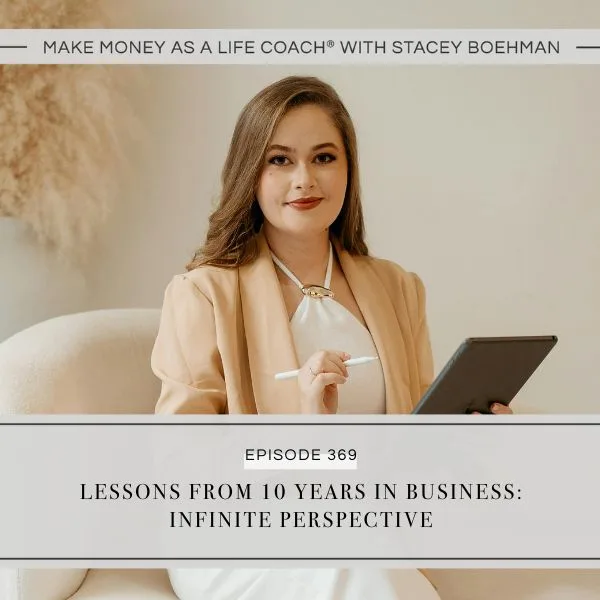
Are you solving for what feels urgent today, only to wake up tomorrow to a brand new fire? In this episode, I’m teaching you what I call infinite perspective, which is the way I filter decisions through the bigger mission instead of the pain of the moment. When you stop letting the now be the loudest voice in the room, you start building a business that can actually hold where you’re going.
I share how I learned this concept from The Infinite Game and how it evolved into a way I think about everything, from money problems to marketing decisions. I explain why small picture thinking can get you moving, but it also keeps you patching the same problems over and over. Infinite perspective asks a different question: how do I solve this in a way that works long term, even if it requires temporary discomfort now?
You’ll hear what it looks like to stay on mission with focus and constraint, and why I protect my energy and attention like they are business assets. This will help you make cleaner decisions, stop creating short-term fixes that become long-term messes, and start leading your business from the version of you who plans to be here for a long time.
Join us now in the 2k for 2k program with a new 12-payment option — just $200 a month for lifetime access! Click here to sign up. Don’t miss out!
Click here to join the 200k Mastermind waitlist!
If you’re ready for a 7-figure year, click here to learn more and join the waitlist for 2 Million Dollar Group!
What You’ll Learn from this Episode:
-
What infinite perspective is and how it changes your decision-making.
- Why solving for the pain of the moment creates a constant fire cycle.
- How to think in permanent solutions instead of temporary fixes.
- Why scaling requires wider, longer-range problem-solving.
- What it means to choose your mission with focus and constraint.
- How protecting your energy and attention supports your long-term vision.
- The questions that move you from current pressure into big picture leadership.
Listen to the Full Episode:
Featured on the Show:
- Click here to sign up for the waitlist for the next round of the 200k Mastermind and get on the email list!
- Join my 2k for 2k program where you’re going to make your first $2000, the hardest part, and then $200,000 using my proven formula.
- Follow me on Instagram!
- Follow me on Facebook!
- Click here to get access to all 5 days of my How To Sell Life Coaching training!
-
The Infinite Game by Simon Sinek
-
Essentialism by Greg McKeown
-
Originals by Adam Grant
Episodes Related to Infinite Perspective:
Full Episode Transcript:

Welcome to the Make Money as a Life Coach® podcast where sales expert and Master Coach Stacey Boehman teaches you how to make your first $2k, $20k, and $200k using her proven formula.
Hi coaches, welcome to episode 369. You’re going to be listening to this on the first week of January, the first Wednesday of January, but I’m recording this on my last day of work before I head off on and my team heads off on Christmas break
I am cozy in my office with a cup of coffee and a flannel Christmas shirt that’s so cozy, and my little warm Ugg boots and just feeling so excited about the holidays. I’m actually, I’m not actually sad, but we’re a little sad over here. We had the most amazing snowy first three weeks of December ever. Like nothing but snow outside for three weeks. It felt like a white Christmas. And then it’s going away and Christmas day, it’s going to be 70 degrees. Make it make sense. This is Kentucky.
So we’re like, what happened? Like, why couldn’t that have just shifted like one week? But it’s not the case. So I hope that you all, if you celebrate any of the December holidays, Merry Christmas, Happy Hanukkah, all of the beautiful wishes that I want to send you your way. And I hope that and if you celebrate nothing, I just hope that you have cozy time with your family, and that you have, is it hygge? Is that what they call it? Just be so cozy and comfy.
And I hope that you have some time to reflect about this year, the past year, and that, well, I’m saying it now, but you’re going to listen to it after the fact. So that’s a little weird. But I hope you had time to sit and reflect and then think about the new year. And if you’re just now doing, that’s great too. Hello.
At the time of recording, I’m going to be delivering a three-year plan event for my students in my 200k Mastermind and 2 Million Dollar groups. So I think this is the perfect episode of, this was always going to be one of my top 10 lessons from 10 years in business. And it’s so perfect that it fell the exact week of the three-year plan event. I don’t know how that happened because it wasn’t intentional. It wasn’t like massive forethought. I think sometimes when you’re just in the current, things align. And so that’s what’s happening here.
So today I want to talk about infinite perspective or infinite thinking. And I want to say, before I dive in, that I first learned of this concept and this idea from Simon is it Simon Sinek or Simon Sinek? I always feel like I mispronounce his last name. But he has a book called The Infinite Game. It’s brilliant. I highly recommend that all of you read it. I have it, I have like a collection of maybe 12 or so books of like my all-time favorite books in business on my shelf in my office. This book is one of them.
I actually used to require, not require, but like request of my 200k Mastermind students for the first several rounds. When they came in before they started, I would tell them to read three books, Essentialism by Greg McKeown, I think is how I’m pronouncing his name right. Then I would have them read Originals by Adam Grant, and then The Infinite Game by Simon Sinek.
Three profound books that really shaped a lot of the ways that I think in my business now and the things that I teach in the 200k Mastermind. And I would say this episode, if you read the book, may be like a far deviation from the way he describes it and how he talks about it because I read it so many years ago, and then I’ve been using it in my own brain for so many years that I’m sure they don’t align, like line up exactly anymore. And this episode really isn’t a recap of his book. So if you want to read that, I think you will hear brand new things, a brand new take, and maybe it will also solidify some things that I do say here, but I don’t think it’s going to be a copy in any way. So I highly recommend that book. It’s very brilliant.
So here’s what I want to share with you all today. A couple of things. So the way that I use the idea of infinite thinking or infinite perspective is that I filter all of my decisions through this perspective. And you can also think of it as just big picture thinking. Like I’m always thinking of the big picture, the infinite perspective. So I think further ahead and wider than just now. I solve problems thinking of the bigger picture.
But what’s challenging is that we live in the small picture, right? Like we live in the smaller picture problems. And our brain tells us that those are the most important. And they’re the most painful because they’re in the moment. The pain now. But if you always solve for the most painful things of the moment, you are always in the moment, like we live every moment in the moment, right? So if you’re always solving for the pain points of the moment, then you just always end up being in the pain.
Like, let me solve this pain right now in this moment, and then let me solve this pain right now in this moment. And it’s just always small picture things that you end up solving. In scaling, a lot of times, I talk about this, and I’ve heard this explained, it’s like the energy of always putting out fires.
If you are someone who’s constantly putting out this fire and this fire and this fire, and it feels kind of hustly, like as soon as I put out one, there’s another one that comes, it’s because you’re solving in a very narrow, small, current thinking versus when you scale, you have to think in three years, how do I want to solve this problem? If there were 10,000 students instead of 1,000, how would I solve this problem? How do I solve this problem forever, not just for today? Because you can solve things for today to get out of the pain very quickly, but those solutions don’t typically work long-term because they’re very hustly, get out of the pain very quickly decisions.
So for example, if you needed, if you were full-time in your business and you needed to come up with money really quick and you threw out an offer that you were never planning on offering again, and it didn’t really fit into anything for the future of your business, you might spend a lot of energy, make a little money, but you didn’t actually solve the chronic thing of why is there not money coming into your business with the offers that you want to be selling, how you want to be selling it. That’s the difference.
And it is kind of, I think you can small decision, current pain point solution your way to 100k, to 200k, to 300k, but the more money you start making, the harder it becomes because those little decisions really start to add up and it just really does become those fires all over the place. And you just never get out of, like we always think, oh, when I finally make $200k, then I’ll be out of the pain.
But I always say, like when you want to, this is something I actually say in the three-year plan, is if you want to double your revenue, think of the top three pain points you have right now in your business, and imagine those being doubled. Like, we think I’m going to double the money, and the pain points go away. No, you’re going to double the money if you don’t solve the pain point first before you double the money, you just double the problems too.
So what you have to do is you have to think, okay, I want to solve my top three pain points in a way that’s so permanent that it becomes even easier to double the money, and the way that I double the money is through solving those three pain points. That’s an example.
So when you infinitely think bigger picture, solving for bigger problems, and I will say you will have to allow temporarily the discomfort of now. You will have to do that. So there will be this like in between because we can’t just, I’m going to give some examples of this, but you can’t always just solve for the future things when there are chronic pain points that have to happen now.
Like, sometimes even with my team, we have to talk about what’s the quick fix and what’s the future fix? And if we can’t implement a future fix, let’s say it’s like a technology thing that’s going to take a lot longer, and yet we have customers that need a solution now, typically what we’ll do is we’ll say, okay, here’s the solution now, the band-aid, and then immediately, not later, not when it’s convenient, not after other projects are done, immediately we start working on the permanent fix. We do them at the same time.
Okay, so there is sometimes the temporary discomfort because solving the current pain point immediately and doing the big picture thing, typically, you don’t just have abundant amounts of time to do that and abundant amounts of energy to do that, right? You’re solving two, you’re basically solving for current self and future self at the same time, but you only have the time and energy of the current self. So there’s going to be like a rub, there’s going to be dissonance, there’s going to be discomfort. But here’s what happens.
Eventually, you get to a place where the now is the result of solving that problem with future-focus thinking, and suddenly you’re thanking yourself, and you’re on to bigger, better problems. So let me give you a real-life example of this from the beginning of my business.
When I first started my business, my bank account, I remember not like when I very first started, but there was a point in time where I had like maybe two or three clients, and I was still pitching, and it was, it would have been January, February of 2016. So I’d been in business maybe six or seven months. And my bank account was negative. And a fun fact, I had spent my last money and knew I was going to make my account negative by buying supplies for a surprise birthday party for the boyfriend who cheated on me and broke my heart at the time.
That relationship and it ending was the greatest gift from God that ever was. I had no idea my hunky Neil was on his way. So that was the reason it was negative. But in general, I was chronically low on money. I was making $60k before taxes. I was paying all my bills, investing in my business, making bigger investments than I ever thought possible. Like I remember there was a time where I thought about going to culinary school and it was $6,000. It was going to go to culinary school in New York, which by the way, now I have a chef who went to culinary school in New York, so that kind of feels full circle as well.
But I remember it being $6,000 and me thinking there’s no way I could ever come up with that amount of money, but my desire just wasn’t big enough because when coaching came around, I paid exactly $6,000 to get certified to become a life coach. So that’s kind of amazing.
But I was chronically low on money. I was investing a lot. I had a one-on-one coach, I was in a business mastermind, I’d gotten certified. Like all of those things were happening while also paying down debt, while also paying for all my bills, and there just wasn’t a ton of money.
So the problem that I had was needing money now, right? My account was literally negative. Like I remember having to call and ask for an advance so that I could buy food to cut up for my demos and to eat. So the problem was needing money now. I could solve that in a now way by working more hours in my business or, and/or by stopping investing in my business. Because if I just stop investing in my business, I probably have enough money to not be negative. But I was thinking infinitely. I was thinking of the much bigger picture of my life in its entirety, of my entire future.
So I did work as many more hours as I could and stretched that as much as I was possible. And that did help a little to like kind of keep me barely above water. And I asked for things like an advance. But with all of my, it was almost like I did that with very little energy. Asked for the advance, go work more hours. None of that needed to really take a lot of brain power. But with the brain power I had, I solved for the infinite perspective.
If I wanted to get out of money issues, I had to make money in my business. If I wanted to be making money in my business, I needed clients, right? I wanted to be ultimately in the future of my life making money with my clients permanently. That was the real problem I wanted to solve. That was the root problem for me, the infinite problem.
If I’m making lots of money coaching clients, I’m no longer pitching, I’m doing what I love, and I’m making more money than I could make pitching, and I’m making more than enough to pay my bills. That’s the problem I want to solve. It’s the much higher level, much bigger problem.
So instead of stressing about the money, and people ask me this all the time, Stacey, how did you sign clients while your bank account was negative? Well, I saw there being two options. So instead of stressing about the money, which was an option, and going into such negative emotion around a negative bank account that I couldn’t function. And I know so many of you spend yourselves out that way. It’s like you feel so negative about money that you, it’s like the stress is so big in your body, you literally can’t function.
But instead of doing that, I focused on creating money in my business. It is very difficult to do. It requires allowing all of those extreme emotions of scarcity and insufficiency and physically not having enough. Like the account is negative. Where’s the next, I literally didn’t know where the next meal was coming from. I was eating the vegetables that I was chopping up. I was asking for advances because I didn’t have the money. So that was very circumstantial, tangible scarcity. And I allowed it and all of the negative emotions that came with it.
And in fact, at one point, right after that, it was like, within a week, the boyfriend and I broke up, and I was devastated. And now, instead of staying in his warm, lovely condo, I’m living in like a Microtel hotel in the middle of winter in Michigan with my dog in this tiny room. And I remember recording coaching videos from that Microtel hotel and running a coach training from that, like a, I don’t remember even what it was, but it was like a six-week training, and I created a video every single day for six weeks straight. I recorded a video.
And so I was in a Microtel hotel recording videos for my coaching business, like in deep heartbreak, negative bank account, focused on the bigger thing I wanted, the bigger picture. And to do that, what I knew I had to do was, which is why I was creating videos every single day, was I had to create value.
So that was one of the prior podcasts that value creates money. I know that deeply in my core. So if I ever feel like I’m in a money crunch, what I know is I’m in a value crunch. Like the money crunch came because there was a value crunch. The money problem happened because I had a value problem way before that.
And if you have a bigger business and you know how to create value, as a side note, it can be sometimes we step out of offering lots and lots of value for many reasons, or we aren’t offering the right value to the right people. But it’s always a value issue. Sometimes we don’t have because we’re suffering on the inside, we don’t have enough energy to go out and give value to enough people for free to get them to come into our business, and our message doesn’t get seen and heard. But it’s always a value issue.
So I knew I had to create value. And to create value, I needed to be serving and not suffering. So I had to feel sufficient even with a negative bank account. Go serve and give value. And eventually, in the future, I started making more money than I ever could have made pitching.
That year, 2016, I made $150,000, more than double of any year ever as the top salesperson in the entire industry with what I did. It was uncomfortable, but I chose temporary current discomfort for my future comfort. That is infinite thinking.
But it’s not just choosing the future over the present. That’s one way that you can do it. That’s one way that it shows up for me. It’s one way that I use it. But the second way that I use it that I think is even more challenging sometimes for people to really see, especially if you’re not living that way, then it might be hard to understand the way I’m going to describe it.
But a second way that you can have infinite perspective and be thinking infinitely is by thinking of your mission and your vision and choosing that and actions and behavior that align with that as the priority above all else. And I do find that it can be very hard for people to choose the mission with great focus and constraint over and over again. We have brains that want to go all over the place.
So once you know what your mission is, and even if you’re a general life coach, your mission could be I want to coach people and help them change their brains because I know the more people that I coach to change their brain, the better the world is. That could be your simple mission.
But then to choose that with constraint over and over again, instead of like, for example, going online and bitching on Facebook about a bad customer service experience, that’s not choosing the mission. And I remember in the very beginning of my business, like, my Facebook activity was not that of a multi-million dollar coach.
I remember I had another friend at the time who was a coach, and she would screenshot things I would post on Facebook and be like, Stacey, stop posting this stuff. Like rants about bad customer service, rants about someone driving random music lyrics. Like, have you guys ever, Neil and I do this all the time. We’ll get an update from like Facebook from 15 years ago, and it’ll be something like really bad and atrocious, and we’ll screenshot it and send it to each other.
So, like that’s not choosing the mission and vision. But sometimes you’re like, I have to get this off my chest. But getting something off your chest is not mission and vision-focused and constrained. And so it was hard to do that over and over and over again. It’s hard for people to see social media in general as their business platform. They want to mix it, business and personal, and then they start thinking, well, it’s been too business-focused, so now it needs to be more personal-focused.
Like, just decide if you decide to be a coach, try it on that if you were infinitely thinking that you’re going to be a multi-million dollar coach one da,y and you want to align everything you post and everything you do with your mission and vision, then you’re going to not need your profile to be a personal space for you.
Family photos, if you don’t want that to be part of your business, you’ll send it to your friends and family. You’ll have conversations with them. You’ll update them privately, and you’ll be fine with them no longer following you on social media. Like, no one in my family thinks I’m going to learn about what’s happening in Stacey’s life if I go to her social media. Not like my private life. They’re going to only hear about my business. I don’t use my personal profile at all.
So I think that’s like one example. I’m going to go more into that, but I do think it’s very hard to choose the mission and over and over again. There are also so many things competing for our attention. There’s so many things that you could action on. There’s so many things that could influence your behavior in your business and in your life that feel very important.
And so you I just started, I remember this was right around Master Coach Training when I went through that, right around the time I was scaling my business. I really had to learn how to constrain down what I spend my time on, what I put in my ears, what I let my eyes see, and what I output into the world as being very focused on the bigger mission and vision, the infinite mission and vision.
So I have a few examples of this. My mission is to help coaches learn to sell so that they can go and help everyone on the planet think and feel better, think and feel more intentionally, and have the benefits of a well-coached brain. I believe that is how we could solve all the problems of the world.
Now, it’s a lofty mission. Do I think that will ever be accomplished? Maybe not. But I do think that the more people hear about coaching and have great experiences of coaching, the more value we create in the industry, the better we, you know, hold ourselves as a profession, the better we act, you know? Like this is why I don’t believe in cancel culture with coaches. This is why I would never say anything negative about a coach. This is why I don’t market by anti-coach hostility. This is other examples of being infinitely focused is I just think it devalues the whole industry.
So anything that devalues the whole industry eventually devalues me. So I only want to add value to the industry. And sometimes it’s not like we can’t always see directly in that moment how that’s going to happen, but I do think it always comes back around.
So that’s my mission. I want to help all the people, as many people on the planet, get coached. I want to add value to the industry. I want to help contribute to a very good reputation of coaching as a profession. So thinking infinitely requires me to not get distracted to stay on that route. I keep my messaging on that route, my marketing on that route, my decision-making on that route, right?
So one of the things I I think about is when I’m marketing or when I’m creating an offer, is does this offer help coaches go, does this thing I’m going to teach them, this thing I’m going to say to them help them go out and help more people? Is this message going to serve them to help more people now, to help more people in the future? Does my marketing reflect this message and this purpose? Like is it aligned with that message and that purpose? Am I putting all of my energy here? Like I ask myself that often. Am I putting all of my energy that I could be putting into the mission and the vision? What distracts my energy from being here in the mission and the purpose, and it being front and center?
One of the ways that I answered that question for myself years ago, and I’ll give you like a concrete example, is I made a decision years ago after I went through master coach training that I was going to stop talking about world events, politics, social issues, and any other type of current events.
My business is about helping life coaches make money and go change the world in that way. And I want to help everybody do that, even people with conflicting beliefs and conflicting, you know, social solutions, like all of the things. But we live in a time where it’s sort of expected for leaders and people with influence and any really anyone selling something on social media, even if you have like a product-based business, it’s sort of become expected that every business will speak out about everything.
Now, I could go on a really long tangent about this, but the things I will say is if you aren’t an expert on the thing, my personal opinion is I think it adding your thoughts is often just noise. And there’s something that I’ve like heard recently that I was like, oh, this is totally it, is we’ve really started requiring what I heard called, and now I call performative grief of our leaders. So something terrible happened. Let me see you grieve. Something terrible happened. Stop what you’re doing and show me your grief so that I know you’re a good person that’s not consumed by making money. Now, we’re not doing this like consciously, but this is what’s happening.
But we don’t ask our nurses and our teachers to do this. We don’t ask our surgeon why they’re not up to date on this current event and what their thoughts are about XYZ or our lawyers. No, we want to know, are they going to like be able to do open heart surgery on us well? We want to know what they’re up to date on that. Do you know all the new ways to make the scars less? Do you know all the ways to use the lasers? What’s your rates of success here? We want them to stay on the mission, right? I want my surgeon on the mission. I want my lawyer on the mission.
But for me, the moment I step out and I get into world events and politics and social issues and current events, it’s I’m not on the mission anymore. And if I, I know this, if I posted everything that made me sad and all of the grief that I had, even just in the last year, I would have been posting at least once a month. There are always terrible things happening. Always. I feel like I’ve been grief-stricken and sad at least once a month this year about lots of different things.
But when I took master coach training, they asked us for six months to turn off the news and turn off and tune out the suffering of the world, which I know sounds so horrible. But with the purpose of focusing on bettering our brain and mastering our craft. And in that I decided, and at the time I was like posting all the time, stuff like that. And I decided I’m going all in. I’m trying everything out.
And in that six months, my anxiety decreased, my energy and brain power was at the absolute max. The level of thinking and the ideas, the concepts, the tools that I created, the amount of work I got done. Again, the happiness that I felt.
In that time, I created the 200k Mastermind, which became a $30 million product generator for me, a $30 million mastermind. And that I went on in that mastermind to help hundreds of coaches make their first six and multiple six figures, and then, and even some of them to go on and make seven figures, all stemming from what I created during that time.
It’s so uncomfortable at first, and it feels so so like, I don’t know, self-absorbed maybe. And our tendency is to want to run towards the terrible things and become absorbed with what’s happening everywhere. And you can absolutely, but what I learned is that there would be an energetic cost to the mission.
So when I think infinitely, I’m thinking about my energy, I’m thinking about my brain power, I’m thinking about what I consume as what becomes me. I’m thinking about every single post is the opportunity to bring people into my world. I’m thinking about the impact on my current clients and my current audience. I often think like each post, every time I show up and speak, it has the opportunity to be the one thing someone needed to hear to keep going in their business.
So I want to use those one moments to demonstrate my philosophy, my process, and my life, the life I’m able to live because of the work, which I think is like the value of doing the work. I want to show someone not just the problem they’re experiencing and why they’re experiencing that. I don’t want to show them just what I think the solution is. I don’t want to just talk about my process and show results for my clients, but I also want to show the value and impact of doing the work through my life. And there’s so much that I could show just in that.
Now, the other thing, the side note that I will say, I have more thoughts, and I think for this specific example, I think it’ll be useful to hear this thought as well. I also think about the power of my voice when I’m speaking about my work. I believe it has potential for profound positive impact when I’m in my lane, in the current, speaking of my work, profound positive impact infinitely. And I think that same power of my voice can also have an infinite negative impact when I’m speaking on things and thinking about things that I’m not an expert in.
And I know that the argument can be, well, you shouldn’t you educate yourself on these very important world things? And the way I think about it is, yeah, I mean, I could become an expert in all things not making money as a life coach, so that I can make sure I speak on everything with the proper education that I should have, understanding the power of my voice. But then there’s not going to be much time left over for me to do my work.
And then some people will go a step further and say, but it influences your work. And I’ve deeply thought about this. And I think that’s only if you believe that there is one side to every situation, in which that one side would then influence my work. But as my audience has expanded to a worldwide clientele, I have found that everything I think is one-sided versus wrong, this is the only correct opinion. There’s been someone I love, and I love working with very deeply that will come to me and show me their side and show me how deeply complex everything is.
It’s easy when you’re like disagreeing with someone, and then you think you hate them. Like you’re like, oh, these people that disagree with me, well, they’re just terrible people. It’s another when you actually use your voice, and you speak up, and then someone you love is like, actually, this is profoundly my experience. Let me educate you on my perspective. And then you’re like, whoa, this person isn’t just someone on the other side of the internet anymore. This is a real human that I love and would never want to hurt with my voice.
Even within like the one side believes this and one side believes that, there’s going to be differing opinions there too on how to handle things. So there will never be a way to say the thing that you might want to say, or I might want to say, without hurting someone I love. And to me, the thought is, what is the value of that? So that a small subgroup of my clients can think Stacey’s a good person to perform activism, to perform solidarity, to perform grief, to show someone I’m a good person, a trusted person. The thought that I have is you either think that or not by knowing me, by feeling me, by experiencing me, or not. And I get to work on the mission either way.
And I found that there are thousands of people who are happy for me to stay on mission. And they tell me that I am a reprieve from the news feed and an example for them to stay on their missions. Comes full circle. And what really completes this belief for me and solidifies it for me is if I believe business is infinite, it means there’s no end. And if it’s continuous, then current events and trends and issues will come and go, and the mission will always remain the same.
So helping coaches sign clients so that they can help the world think and feel more intentionally, so that the world inherently becomes a better place, will be the only thing that doesn’t go out of style, the only thing that doesn’t change in a world of continuous change.
Okay, so my final example of this of how I use infinite perspective and infinite thinking is how, when and why I choose my offers. So my current core offers are 2k for 2k, 200k Mastermind, and 2 Million Dollar group. And I actually have a podcast that I recorded a very long time ago called Mission Millionaire. And I talk about how in that episode, my infinite goal is to help coaches become millionaires. And to do that, and just make a lot of money along the way, even if they never became millionaires, but I’m just shooting for millions.
So to do that, I have to support them with everything they need to keep going until they get there, to keep going, to keep growing until they get there. And I am the sales queen. I have deemed myself that. So I teach my students the skill set of selling in order to do that, selling to make millions.
So in the beginning, I teach them how to show up and sell when they have no intellectual property, no audience, no experience, and likely zero business resources. And I teach them that in my 2k for 2k program. It’s like how to literally only require a cell phone and sign those first few clients, make $2k and $20k. I teach them how to master the one-on-one sales conversation, which is the easiest way to convert clients, especially if you don’t have an audience.
Then in my 200k Mastermind, I teach them how to start building that audience and how to develop their own intellectual property, how to sell even still with little resources, all the way to $200k. I teach them how to fill their groups, their first groups, how to make that first $100k, how to make that first $200k, maybe even how to make that first $100k in a group by being really good at selling and needing again nothing more than the cell phone.
And then what happens if they can do that, they can do that all the way to $200k. Now they have this insane skill that will keep them in business forever, no matter what changes in the world and what changes with algorithms, what changes with platforms, what changes with technology, they will have infinite business skill sets.
Then in 2 Million Dollar group, I teach them how to sell in the one-to-many model. That’s the hardest form of selling, but it makes you a millionaire when you finally get it. It can make you a millionaire when you finally get it. And if you get to that level, it creates hundreds of thousands of dollars, if not millions of extra dollars in profit, because you convert a higher percentage of your audience than your peers.
And so therefore, you need to spend less money on client acquisition and less time growing your audience to huge and huge volumes of people because you can only sell that small percent of that volume, right? Like when you can only sell a very small percent of volume, you have to just be, I mean, client acquisition out the like crazy, right?
Versus, I know how to sell really well the people I have. I’m still acquiring clients, but I really know how to sell the people I have, that will increase your revenue, skyrocket your revenue, skyrocket your profit, and help you, like I made millions with a very small audience size. I still make millions with a very small audience size.
So that’s my core offers. All three of those income levels, teaching them how to be amazing at selling. And even what I would say is marketing, selling, and delivering. That’s what I call the three-part business engine. And I teach them that in each of those three rooms.
But now, I have also identified a new need. And listen, maybe it’s always been there. I think I’ve been depending on other programs and other coaches and other methods to help my people with this problem, with this need. And I realized about a year ago, thinking of my three-year plan, thinking of my infinite vision, focused on the infinite perspective, that I was going to need to start filling that gap myself and knowing I’m the best person to do it for my people, and that if I do, my people will grow infinitely faster and deeper, especially combined with my other programs. Like, there will be no gaps from this moment on, and it feels so exciting.
And I’ve been spending the last year because when I realized this, I didn’t feel like the person capable of taking on such a big task alongside my other offers and while having littles at home. And so for the last year or so, like 18 months, I’ve been working on becoming that person and making it inevitable. Like in my own coaching work, the way that I show up to my business and in my own capacity work, I’ve been silently becoming the version of me that can do this new work, host this new work, and teach this new work.
So it was a behind-the-scenes move, investing a lot of time and energy to fill a need that will have infinite reward for my business and my clients’ businesses. And I find like it’s very hard for people to imagine working to become someone for 18 months without telling the world about it and going out and making the offer too soon, but making the offer once I actually have become the person. Like it’s such a big picture move.
But because I want to create more people qualifying into the millionaire room, and I’ve been thinking, how do I do that? Ever since I had that podcast and even before that, how do I create more millionaires? Like, what do I need to solve for them? How do I make this better for them? How do I make this faster for them? What else do I need to teach them? And I believe this new offer is going to be the next piece of the puzzle.
You will hear my big infinite why when I launch next week. Like, why this new offer matters, what this new offer is about, what the big mission and infinite vision is of it. But this is just an example of when I’m thinking infinitely versus like what’s the offer I want to have now, or what could I sell now? What could I make money on now? Like, those are not the way I make my decisions, despite maybe what the naysayers want to say about me, it’s not how I make my decisions. Again, I just can’t believe this episode fell on this week. I just think it’s the best, most perfect timing.
Okay, so there are so many ways that big picture infinite thinking can be used. Again, I’m about to do an entire week of my three-year plan event for my mastermind students in 200k and 2 Million Dollar Group. I’m going to take them through my three-year planning process. I actually created the three-year plan course to get my students to think bigger and more infinitely about their goals and the things that they need to do today to achieve their goals three years from now, like I’ve done with this offer. And I think three years can even be a challenge to face, and like take really seriously what doing something today for three years from now. And so I guide them through that very carefully.
But what I will say is now, after creating three-year plans for the last 10 years in my business, now I’m starting to think five years away. Like, what do I need to do today? What’s the work this year in order to get where I’m going in five years? And what matters the most towards my five-year plan? So this offer, again, as an example, is one of those five-year decisions for my students’ growth and for my business’s growth.
But I think to start, if you were wanting to like play around with infinitely thinking, so if you’re in 200k and 2 Million Dollar group, you’re going to learn to do it in a three-year time span. But if you’re listening to the podcast and you want to try this on, what could be helpful is not using a timeline at all, but just thinking infinitely, like thinking big picture, long-term, like not assigning a three-year or a five-year because sometimes in the beginning you’re like, I don’t know what is going to happen three years from now or five years from now. But I think the more money you make and the longer you’re in business, you’re like, okay, I see what, you know, the past, the future, like I can start to relate to timelines.
So if you’re not there yet, just try to think in the big picture, long-term, what do I want? If I were going to be in business infinitely, how would I look at this? How would I solve this? If I were planning to create an infinite asset of my business, what would I do today to grow that asset? Who do I need to become to stay in business infinitely? That’s a really good one.
Or you could ask yourself, who do I need to become? What skills do I need to create over the next few years, if it’s hard to think infinitely, over the next few years, if I want to become a very successful entrepreneur and coach? What are the thoughts I need to have about myself? What are the skills I need to have? Who do I need to be? What do I need to become? Like, what do I need to be able to do? Like, what needs to change in me to become a very successful entrepreneur and coach? Even if the list is exhaustive, it’s your road map, right? People get very overwhelmed by exhaustive lists, and I’m like, no, this is amazing. It’s a step-by-step GPS.
Like, and I think from the get-go, I made my decisions this way. I used this kind of line of thinking to get through figuring out the hard things, like my first sale, building my audience. Like, even the concept of over-delivering for me. Like, people always ask about my marketing plans. When I believe this from the very beginning, the way I took care of my very first clients.
Like if you asked my very first clients, who are some of my best friends today, still in my life today, my very first two clients, if you ask about my marketing plans, I think they would tell you this is true. I am a living proof of this. The first thing on my plan is over-delivering the offers that I make, over-delivering on the offers I make. And my number one way that people find me is through referrals. So that is a direct result of the thinking that if I always undercharge and I always over-deliver, I’ll never ever run out of clients and stop making money. I will make money infinitely. Isn’t that wild?
Like, even from the very beginning. I just think about like what would I need to do to have clients forever? What would I need to do, not like keep the same clients forever, but have clients forever? What would I need to do to have tons of referrals coming into my business always? Like big picture, if I want to be the referral queen, what does that look like? If I want to have an amazing reputation in the industry, what does that look like? I just ask myself these bigger picture questions.
And then again, the same with my investments. I think I don’t make the small investments, of like how can I solve this problem and make it go away now? Even with my employees, I’m looking for like not who can fill the gap now, but who will forever be able to fill the gap? What investment can I make next that will infinitely serve me in the future? Like all of my questions are like that. It always comes back to the big picture for me.
So that is one of my lessons. I’m having so much fun with these. I will have another one for you next week as well. But I hope you enjoyed the infinite perspective, infinite thinking. And I really, even if your infinite thinking is not the same as my infinite thinking, I want to offer and highly suggest that you try this on.
All right. Happy New Year, my friends. I hope you have lots and lots of big goals, and if I can help you with any of them this year, let’s go. All right, I’ll talk to you next week
Hey, if you’re ready to make money as a life coach, I want to invite you to join my 2k for 2k program; where you’re going to make your first $2,000 the hardest part using my simple five-step formula for getting consults and closing new clients. Just head over to StaceyBoehman.com/2kfor2k. We’ll see you inside.